Text · Draft · 2026-10-22
The Estimating Image
Technical images, Gaussian splats, simulations and memory — and what an archive of the living asks of design
Text · Entwurf · 2026-10-22
Das schätzende Bild
Technische Bilder, Gaussian Splats, Simulationen und Erinnerung – und was ein Archiv des Lebendigen von der Gestaltung verlangt
(Chapter 00)Opening
The crow at 24 %
On 7 October 2026 at 10:20, one of us stood at the yacht harbour in Bregenz, 47.5294° N, 9.7410° E, and recorded 66 seconds of sound with a phone. The recording went into our course archive as a marker. Two weeks later a bird model listened to it.
The model, BirdNET 2.4, expected 120 species for that place and that week. It found one thing: between second 6 and second 9, a carrion crow — Rabenkrähe — at a confidence of 0.241. Beside it, a hooded crow at 0.152; under our display threshold, later in the recording, a song thrush at 0.113. The thrush is in the record; the card shows only the two crows. [S27]
The card on the map says „Rabenkrähe Corvus corone · 24 %“ [verified]. Under it, in the small mono line: „Arterkennung: BirdNET 2.4 (Cornell Lab of Ornithology & TU Chemnitz) · automatische Schätzung, nicht verifiziert“ [verified] — species identification, automatic estimate, not verified. That line is the subject of this article.
BirdNET's own documentation says what the number is not: “BirdNET confidence values are not probabilities but a measure of the algorithm's prediction reliability.” [verified] So the card does not say there was a crow. It says an estimator, trained mostly on recordings made elsewhere, read this sound and leaned 24 % towards crow. [S15]
That is an honest image. We will argue that most of the images we now live with are of this kind — and that most of them hide their 24 %.
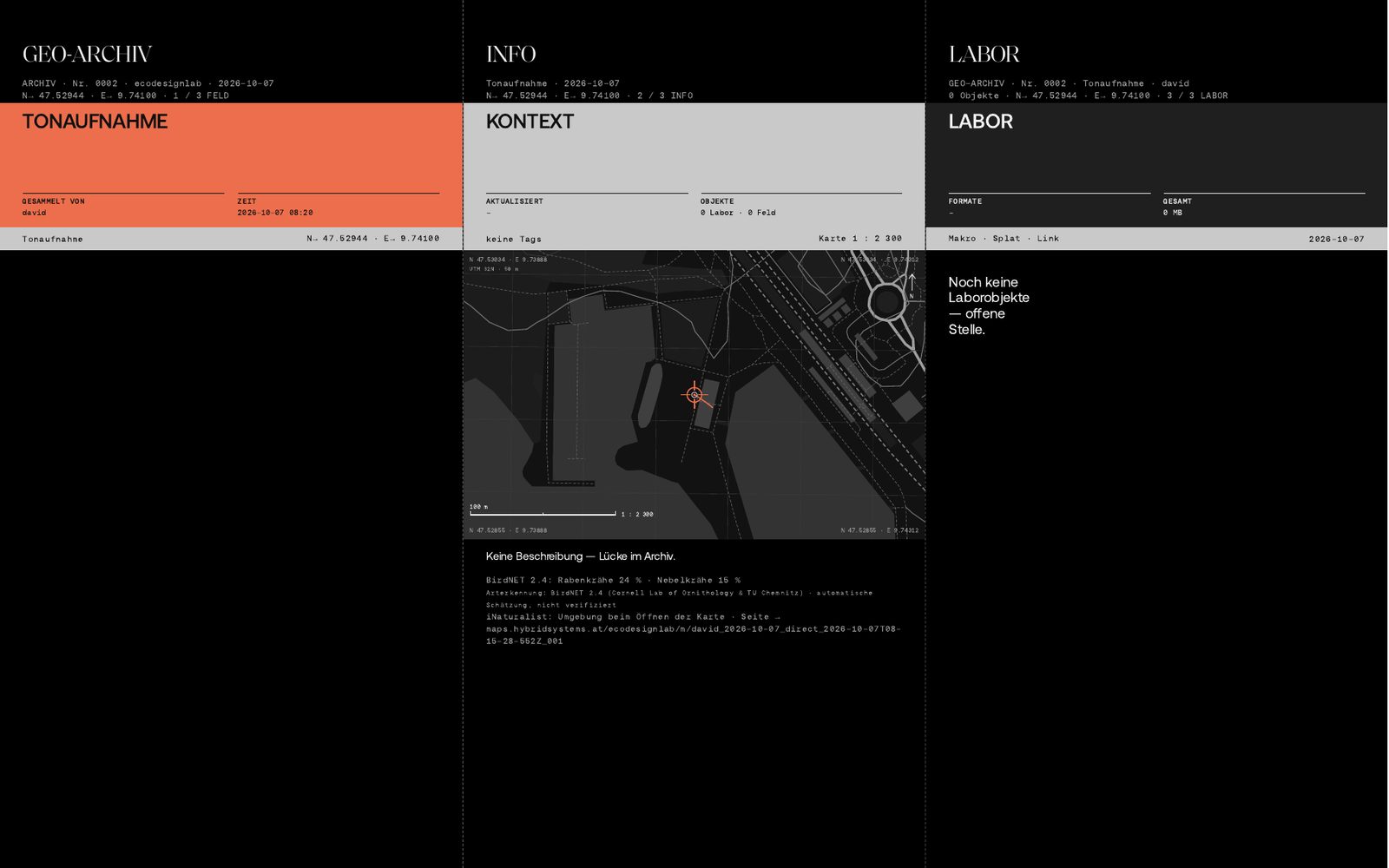
Fold-out A3 · Marker Nr. 0002 · page 1 (01)
the fold-out of the crow marker in A3, front (page 1, centred 16:10 crop) — Feld | Info | Labor panels of 140 × 297 mm, the vector map excerpt at 1 : 2 300, the mono source line printed at reading size. The fold-out is the apparatus printed with the image. Source: print pipeline /api/print/<marker_id>?format=a3 on the lab server (vector map from MapTiler tiles, PDF via Chromium) · generated 2026-10-22 · rendered PDF page 1. © MapTiler © OpenStreetMap contributors; BirdNET 2.4 (Cornell Lab of Ornithology & TU Chemnitz).

Archive card, Info page · species rows (02)
Info page of the card, species rows and attribution line, cropped. Source: maps.hybridsystems.at/ecodesignlab · captured 2026-10-22 · Playwright screenshot of the card element.
(Chapter 01)Flusser · Gaussian splatting
A technical image is a map
In 1983, in Für eine Philosophie der Fotografie, Vilém Flusser writes: „Bilder sind bedeutende Flächen“ — images are significant surfaces (Flusser [1983] 1989 ff., S. 8; Reaktion 2000, p. 8) [verified]. They mediate between the world and us, and then: „Sie sollen Landkarten sein und werden zu Wandschirmen: Statt die Welt vorzustellen, verstellen sie sie …“ (S. 9; Reaktion p. 10) [verified] — they are supposed to be maps but turn into screens; instead of presenting the world, they obstruct it. [S1]
The technical image, the image produced by apparatuses, sharpens this. “Ontologically, traditional images signify phenomena whereas technical images signify concepts.” (Reaktion 2000, p. 14) [verified] Their “apparently non-symbolic, objective character […] leads whoever looks at them to see them not as images but as windows.” (p. 15; German: „nicht als Bilder, sondern als Fenster anzusehen“, S. 14) [verified] [S1]
In Ins Universum der technischen Bilder (1985) Flusser says how such an image is built: computed, not drawn. „Übrig bleiben dimensionslose Punktelemente, die weder faßbar noch vorstellbar, noch begreifbar sind – unzugänglich für Hände, Augen und Finger. Aber sie sind kalkulierbar (‚calculus‘ = Steinchen) und können mittels spezieller, mit Tasten versehener Apparate gerafft (‚komputiert‘) werden. Man kann diese mit Fingerspitzen auf Apparat-Tasten drückende Geste ‚Kalkulieren und Komputieren‘ nennen. Dank ihr entstehen mosaikartige Raffungen von Punktelementen: die technischen Bilder. Ein komputiertes Universum, in welchem Punktelemente zu scheinbaren Bildern eingebildet werden.“ (Flusser [1985] 1999, S. 14, zit. n. Bruns 2009, S. 9) [open for verification] [S2]
In our translation: what remains are dimensionless point elements, ungraspable and unimaginable but calculable — calculus, the little stone — gathered, “computed”, by apparatuses with keys; the gesture of pressing the keys is calculating and computing, and from it arise mosaic-like gatherings of point elements: the technical images. Nancy Ann Roth's English mostly writes “particles” for Punktelemente (2011, p. 10) [verified]; the word “point” mostly disappears, so we read the German.
He knows the surface is a fiction: „ist es unmöglich, Punkte zu Flächen zu ballen. Da jede Fläche aus unendlich vielen Punkten zusammengesetzt ist, wären unendlich viele Punkte zu raffen, um tatsächliche Flächen herzustellen.“ (Flusser [1985] 1996, S. 26, zit. n. Kirchartz 2023, S. 215 f.) [open for verification] In Roth's English: “Therefore the envisioner can produce only a virtual image, that is, a surface full of intervals, like a raster. The envisioner must be content with the appearance of surface, with trompe l'oeil.” (Roth, p. 21) [verified] And the summary sentence: “on close inspection, they all prove to be envisioned surfaces computed from particles.” (Roth, p. 33) [verified] [S2]
In 2023 Kerbl, Kopanas, Leimkühler and Drettakis published 3D Gaussian Splatting. Their input is “a set of images of a static scene, together with the corresponding cameras calibrated by SfM […] which produces a sparse point cloud as a side-effect. From these points we create a set of 3D Gaussians […], defined by a position (mean), covariance matrix and opacity α” (Kerbl et al. 2023, arXiv v1, p. 1:4) [verified]. [S3]
A splat, then, is not a photograph of the moss but a cloud of small probability distributions, each with a mean and a covariance, reshaped until the cloud reproduces our photographs. Every view rendered from it is an inference — often from a camera position where no photograph was taken.
The paper also names where the method breaks: “our optimization can get stuck with floaters close to the input cameras” (p. 1:5) [verified]; “In regions where the scene is not well observed we have artifacts” [verified], and the method “can create elongated artifacts or 'splotchy' Gaussians” (p. 1:10) [verified]. Floaters, splotches, elongated Gaussians: this is what the estimator does where it was not shown enough. [S3]
This is Flusser's point made literal: a “surface full of intervals, like a raster” [verified], gathered from point elements by an apparatus with keys, forty years before the paper. It signifies concepts — means, covariances — and shows us a window. A splat of a Sphagnum cushion from our moss lab looks like the cushion; it is a map of the photographs we had, with the gaps filled by the prior of the method.
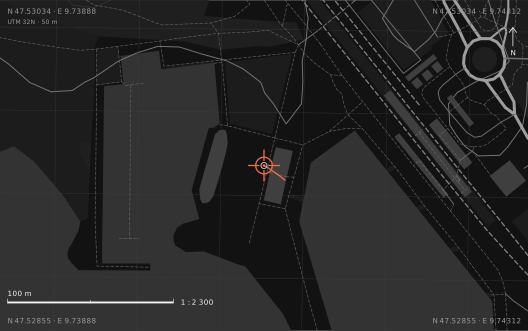
Vector map excerpt · Marker 0002 · 1 : 2 300 (03)
the vector map excerpt around the crow marker, built from tiles, not from a screenshot — one SVG group per layer (MapTiler v4 vector tiles, MapTiler contours, course overlays), scale 1 : 2 300. Source: print pipeline mapsvg.mjs on the lab server, marker david/0002 · generated 2026-10-22 (SVG metadata) · © MapTiler © OpenStreetMap contributors.
(Chapter 02)Lake model · ensembles
Simulations, computed in time
Our second course, the Design Challenge, works with a numerical model of Lake Constance: a bathymetry, a wind and inflow forcing, and a solver that moves water through time on four lab machines, writing a frame every twenty-three to forty-five minutes. [S23]
This week the runs failed their own test. Our lab's morning brief, compiled from the run log of 21–22 October: “MOUTHS FAIL 31 rows (Alpenrhein M3 M4, Argen M2, Bregenzer M5, nine small rivers M1–M3) and drift FAIL (15 m median swing 38°)” [verified]. And: “The Rhine still turns right (+61.5°), so the wedge cut did not remove the T127 turn.” [verified] The brief's own recommendation for the day: “Present them as tests, not as validated results.” [verified] [S23]
A river mouth that curls the wrong way is a floater in another medium. It convinces the eye — water moves, plumes spread, the picture looks like observation — and it is an artefact of the estimator: of the grid, of the boundary condition, of the wedge someone cut into the bathymetry to make the inflow behave.
Weather services have long lived with this. The ECMWF on its ensemble: “Multiple simulations are run, each with a slight variation of its initial conditions and with slightly perturbed weather models. These variations represent the inevitable uncertainty in the initial conditions and approximations in the models.” (p. 1) [verified] And: “Single 'deterministic' forecasts can be misleading” (p. 1) [verified]. [S4]
The ensemble is the honest form of the simulated image: not one picture but fifty-one (p. 2) [verified], and the spread between them is part of the content. A single convincing run of the lake is a window. The spread is the map.
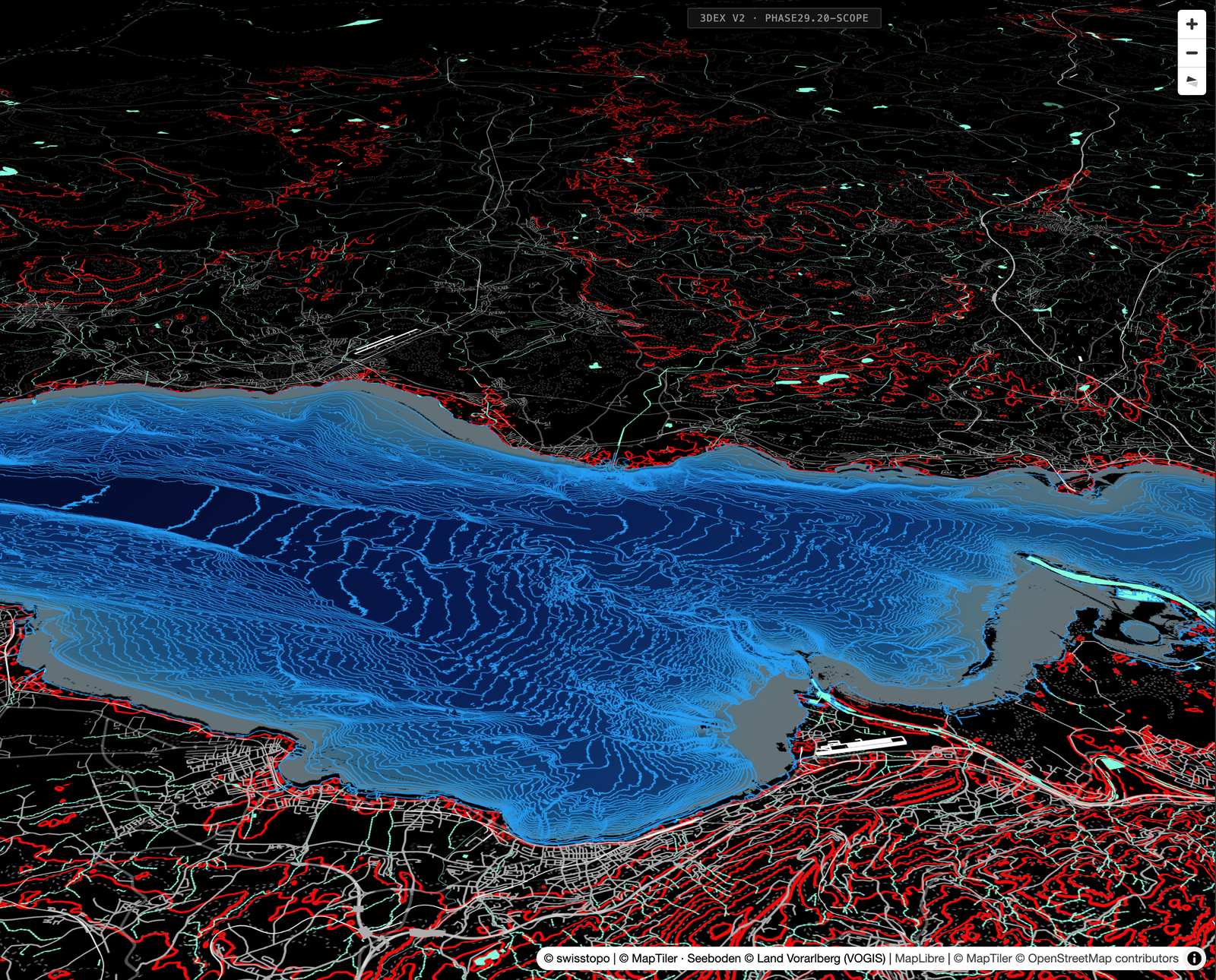
Lake bed · perspective, pitch 62° (04)
the bed of Lake Constance shown as terrain, the water made transparent. Source: VOGIS depth model (tiefenmodell 1 m, 2014, © Land Vorarlberg) via WCS, merged client-side into MapTiler terrain-rgb-v2 (merge-dem), draped hillshade and depth tint; editor geobridge.hybridsystems.at · captured 2026-10-22 · Playwright screenshot of the live editor. This is the editor's lake-bed terrain, not the lab's simulation input. © MapTiler © OpenStreetMap contributors.
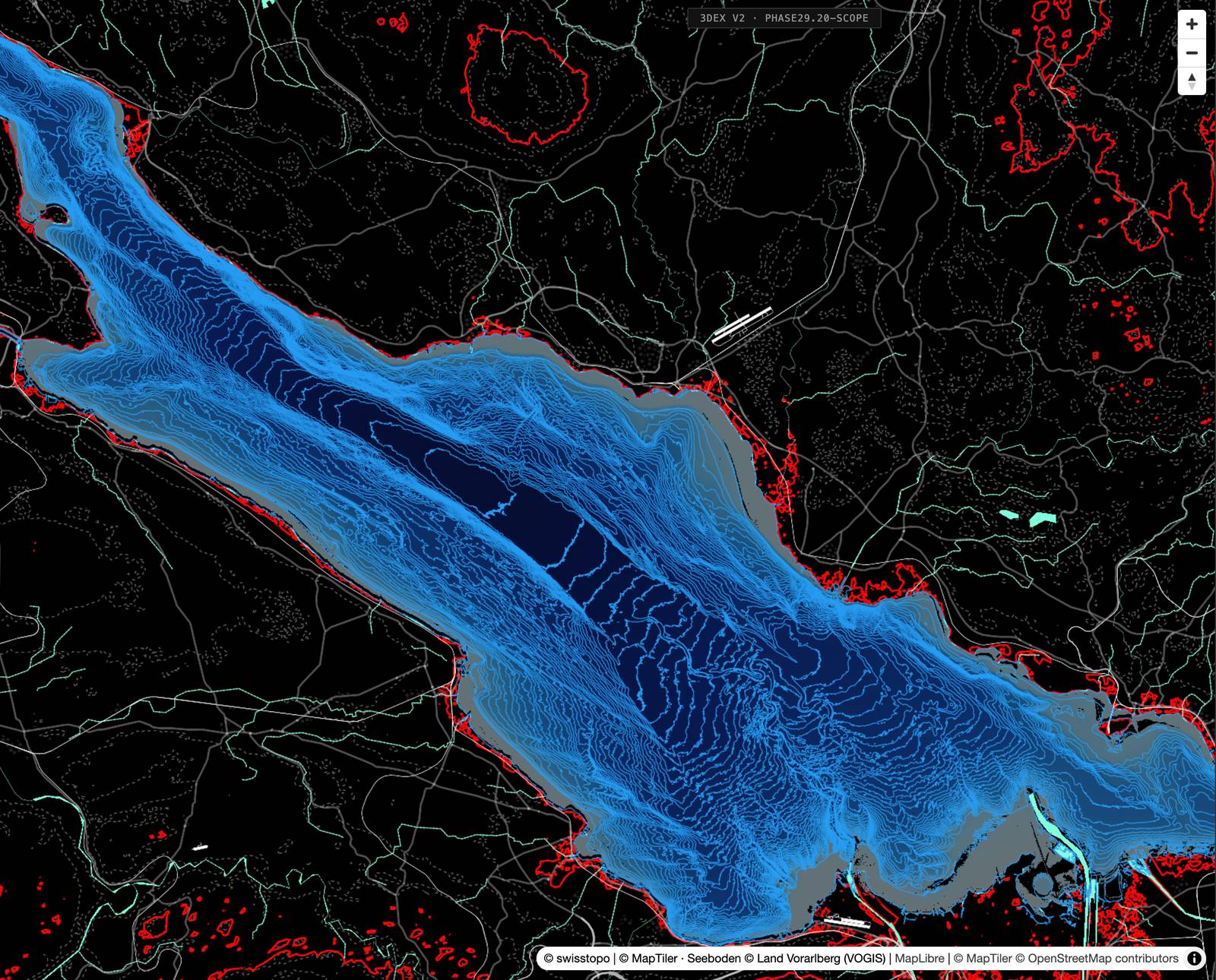
Lake bed · top view (05)
the same lake-bed terrain in top view, depth lines (VOGIS) as vector tiles. Source and method as 03 · captured 2026-10-22.
(Chapter 03)Bartlett · Schacter · Loftus · Assmann
Memory is an estimate too
We tend to hold human memory against the machine, as the warm and true thing. Psychology has said otherwise for ninety years. Frederic Bartlett, 1932: “Remembering is not the re-excitation of innumerable fixed, lifeless and fragmentary traces. It is an imaginative reconstruction, or construction, built out of the relation of our attitude towards a whole active mass of organised past reactions or experience, and to a little outstanding detail which commonly appears in image or in language form.” (Bartlett 1932, p. 213) [verified] [S5]
- “It is an imaginative reconstruction, or construction”— Bartlett 1932, p. 213 [verified]
Schacter and Addis, 2007a: episodic memory is “a fundamentally constructive, rather than reproductive, process that is prone to various kinds of errors and illusions” (p. 773) [verified]. Memory is built from pieces in order to simulate the future: “A memory that works by piecing together bits of the past may be better suited to simulating future events than one that is a store of perfect records.” (Schacter & Addis 2007b, p. 27) [verified] [S6] [S7]
Elizabeth Loftus showed how the pieces get swapped. In 1974 she and John Palmer showed people a film of a car accident and asked how fast the cars were going when they “smashed” or when they “hit” each other. A week later, “those subjects who received the verb smashed were more likely to say 'yes' to the question, 'Did you see any broken glass?', even though broken glass was not present in the film.” (Loftus & Palmer 1974, p. 585) [verified] And: “All we have is one 'memory.'” (p. 588) [verified] [S8]
Put the three next to each other. A memory is a stored distribution plus a rendering at recall time, which takes whatever is at hand — a word from a lawyer, a photograph seen later. A splat is the same at view time, rendered through the prior of the method; a forecast the same at run time. The honest versions carry their uncertainty — a Gaussian its covariance, an ensemble its spread, a memory its felt doubt. The dishonest versions hide it.
Aleida Assmann gives the archive side its vocabulary. Cultural memory has „ein Speichergedächtnis und ein Funktionsgedächtnis. Das Speichergedächtnis sammelt und bewahrt Quellen, Objekte und Daten, unabhängig davon, ob sie von der Gegenwart gebraucht werden […]. Das Funktionsgedächtnis ist demgegenüber ein aktives Gedächtnis“ (Assmann 2008) [verified] — a storage memory that collects regardless of use, and a functional memory: the small, active selection a society makes current again. [S9]
(Chapter 04)Harley · Peluso · the long tail
Every map has silences
Brian Harley, 1989, in Deconstructing the Map: “Much of the power of the map, as a representation of social geography, is that it operates behind a mask of a seemingly neutral science.” (p. 7) [verified] “The steps in making a map – selection, omission, simplification, classification, the creation of hierarchies, and 'symbolization' – are all inherently rhetorical.” (p. 11) [verified] And: “the map is never neutral.” (p. 14) [verified] [S10]
- “the map is never neutral.”— Harley 1989, p. 14 [verified]
Nancy Peluso, whose counter-maps are in the title of our Expanded paper, wrote in 1995 on Kalimantan: “Alternative maps, or 'counter-maps' as I call them here, greatly increase the power of people living in a mapped area to control representations of themselves and their claims to resources” (pp. 386–387) [verified]. [S12] Jeremy Crampton and John Krygier: “Maps are active; they actively construct knowledge, they exercise power” (2005, p. 15) [verified]. [S11]
Now read Harley's list — selection, omission, simplification, classification — as a description of a trained model. An estimator renders the centre of its training distribution and suppresses the tail. That is not a bug; it is what fitting means. The silences of a hand-drawn map are the cartographer's choices. The silences of an estimator are the shape of its data.
The data are not flat. The iNaturalist dataset paper of 2018: “the natural world is heavily imbalanced, as some species are more abundant and easier to photograph than others.” [verified] And: “we observe poor results for classes with small numbers of training examples” (Van Horn et al. 2018, p. 8769) [verified]. [S13]
Udandarao and colleagues measured this in 2024 for the large multimodal models: they “require exponentially more data to achieve linear improvements in downstream 'zero-shot' performance” (p. 1) [verified], and their training sets have “an extremely long-tailed distribution of concept frequencies […], with over two-thirds of concepts occurring at almost negligible frequencies” (p. 7) [verified]. Among the rarest concepts: “eggnog, wormsnake, and tropical kingbird” (p. 8) [verified]. [S14]
So a generated landscape image maps what was photographed most. That is the opposite of what disappears. The rare species, the one that matters for extinction, lives in the tail that the estimator was built to smooth away. Extinction as a crisis of representation — the argument of our Expanded paper — meets an image technology that is biased against the rare by construction.
Ivar Puura called the loss of the signs themselves semiocide: “a situation in which signs and stories that are significant for someone are destroyed because of someone else's malevolence or carelessness, thereby stealing a part of the former's identity.” (Puura 2013, p. 152) [verified] A generated landscape that forgets the thrush is semiocide at the speed of a GPU. [S16]
Back to the crow. The card lists the hooded crow; the thrush stays in a data field, candidates_below_threshold, that no card or print of ours reads. Our apparatus suppresses its own tail — a finding about our design, not a feature of it: the doubt is visible, the tail is not. A generated “typical” bird of this lake, at 100 %, is the dishonest case — same technology family, opposite design.
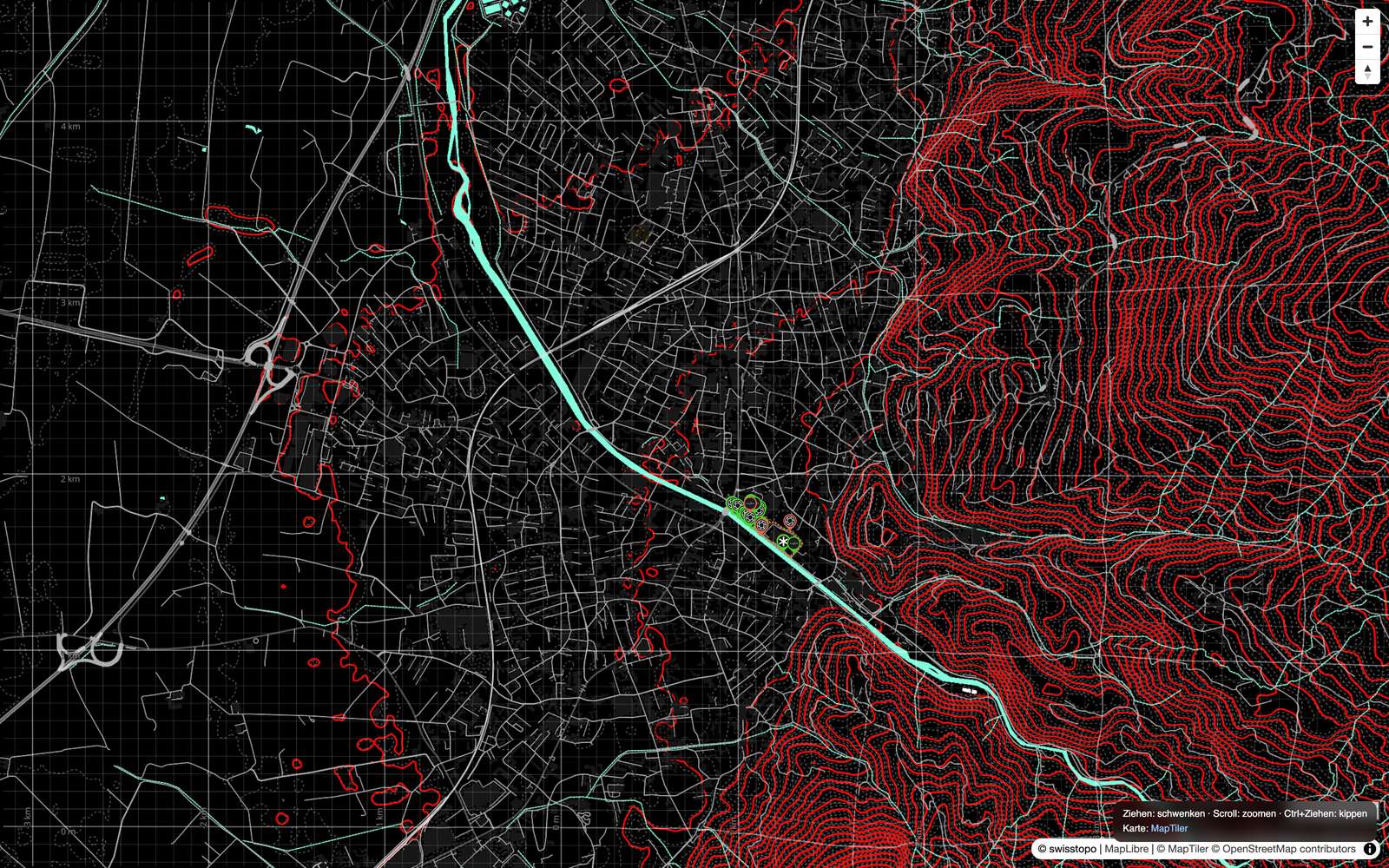
Course map · Dornbirn, contours (06)
the Ecodesignlab course map over Dornbirn in the course's own MapTiler style (ECODESIGN): contour lines in red, the Dornbirner Ach in cyan, the metric map grid with km labels, the course's markers clustered near the river. Source: maps.hybridsystems.at/ecodesignlab · captured 2026-10-22 · Playwright screenshot of the live page, 1600 px. © swisstopo · MapLibre · © MapTiler © OpenStreetMap contributors.
(Chapter 05)Five rules
Print the apparatus with the image
Flusser's demand was to decode technical images. Under generative conditions that becomes a design task, and we have written it into our manifesto as thesis 02: „Ein technisches Bild ist eine Karte. […] Deshalb legt jedes unserer Bilder seine Codierung offen.“ [verified] — a technical image is a map; therefore each of our images discloses its encoding. Five rules follow. [S20]
One: treat every computed image as a map and print its apparatus with it — source, dataset, date, method, confidence, authorship. On our cards and fold-outs that is the mono line. It is not a caption; it is the legend of the map.
Two: render uncertainty as form. The crow at 24 % is typeset as 24 %; the thrush below the threshold belongs on the card too — today our card drops it. A splat is shown next to its photographs. A lake run is labelled with its gate result — test run, mouths not yet right — on the picture, not in a report.
Three: keep the human trace as a second register that the estimator cannot produce — the walk, the recording, the hand-set tag, the student's name. Thesis 08 calls this ambivalence as composition: „Das Daten-Register steht neben dem gelebten Register: Feldfoto, Tonaufnahme, Handnotiz, Splat.“ [verified] — the data register stands next to the lived register: field photo, sound recording, handwritten note, splat. [S20]
Four: keep the image open to correction. The archive card is a page stack that can be added to; a marker can be re-analysed; a species row can be contested. In our Expanded paper: “archival entries are not stable: they can decay, merge, or reappear in new constellations, embodying the idea that preservation under conditions of planetary change is always incomplete, contested and subject to forgetting.” (Köhl & Altweger 2026, p. 3) [verified] [S18]
Five: prefer the ensemble to the single run. If a thing can only be shown as one convincing picture, it is a window.
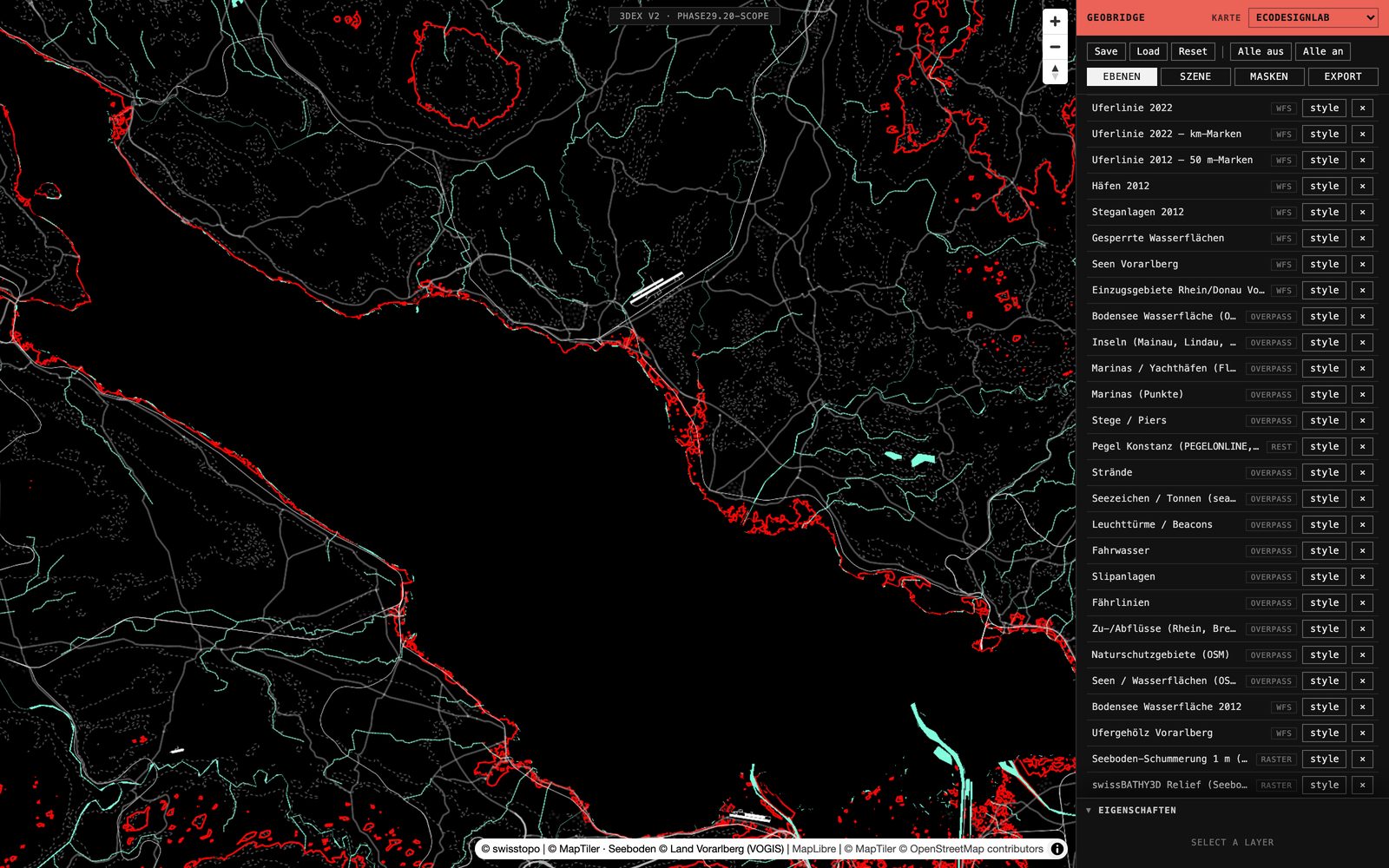
Course-map editor · layer list (07)
the layer panel of the course-map editor — the course map's own MapTiler style plus added data layers (VOGIS, Lake Constance catalogue, masks), each with its visibility and paint. Source: geobridge.hybridsystems.at · captured 2026-10-22 · Playwright screenshot of the live editor. © Land Vorarlberg (VOGIS), © MapTiler © OpenStreetMap contributors.
(Chapter 06)Necropolitics · Brutalism
Mbembe — the living, the non-living
Our paper builds on Achille Mbembe's necropolitics: extinction as part of an order that decides “whose lives are preservable, expendable or structurally unrepresentable” (Köhl & Altweger 2026, p. 1) [verified]. [S18] His own definition: necropower accounts for the ways “weapons are deployed in the interest of maximally destroying persons and creating death-worlds, that is, new and unique forms of social existence in which vast populations are subjected to living conditions that confer upon them the status of the living dead.” (Mbembe 2019, p. 92) [verified] [S21]
In Brutalism he writes about our material, the digital and the living: “The twenty-first century has indeed begun with a spectacular return to animism. This is no longer the nineteenth-century's animism, whose expression is modeled on the worship of ancestors; this new form is based instead on the cult of the self and of objects as our multiple doubles.” (Mbembe 2024, p. 7) [verified] And: “There is a becoming-object of humanity that is the counterpart of the becoming-human of objects. We are the ore that our objects are tasked with extracting. The objects act with us, make us act and, especially, animate us.” (p. 7) [verified] [S22]
The new animism “merges with electronic and algorithmic reason, which is its medium and its envelope, and even its motor. […] It announces—perhaps—the end of dichotomies. But it is also able to serve as a privileged vector of the neovitalism that feeds neoliberalism. The new animist spirit must therefore be critiqued. The aim of this critique would then be to contribute to protecting the living against the forces of desiccation.” (p. 7) [verified] [S22]
Three of his observations change our objects. First, on data: “Humanity has never had so much information and data on hand about almost everything, indeed about all that which lives (le vivant).” (p. 40) [verified] And: “to know, in these conditions, has meaning only insofar as it permits draining, drilling, and extracting.” (p. 41) [verified] Second, on computation: “Behind each statistic, each code, and each algorithm lies hidden a division of the world and the real, an idea and a theory, that is, an idiom capable of generating the reality that it claims to describe or encapsulate.” (p. 44) [verified] That sentence could stand under a splat, a lake run or a BirdNET score: Flusser's technical image, seen from the side of power. [S22]
Third, on loss: “neovitalism does not know how to live with loss.” (p. 8) [verified] [S22] The museum, in Necropolitics, is “a space of neutralization and domestication of forces that were once living forces” (2019, p. 172) [verified]. [S21] A splat that keeps a dying plant alive on screen without mourning it is what his critique targets. One that keeps the loss visible — the date, the state of the bog, the sample since dried — leaves room for what he calls the antimuseum, “a kind of attic of the future, whose function would be to welcome what must be born but is not yet there” (2024, p. 8) [verified]. [S22]
An older sentence names what such a record can do. In 1969 the German Federal Constitutional Court ruled on the census: „Mit der Menschenwürde wäre es nicht zu vereinbaren, wenn der Staat das Recht für sich in Anspruch nehmen könnte, den Menschen zwangsweise in seiner ganzen Persönlichkeit zu registrieren und zu katalogisieren, sei es auch in der Anonymität einer statistischen Erhebung, und ihn damit wie eine Sache zu behandeln, die einer Bestandsaufnahme in jeder Beziehung zugänglich ist.“ (BVerfGE 27, 1 [6] – Mikrozensus) [verified] — it would be incompatible with human dignity if the state could register and catalogue a person compulsorily in their whole personality, even anonymously in a statistical survey, and so treat them like a thing open to inventory in every respect. The court spoke of persons. An archive of the living catalogues moss, crows, a bog, which no court protects from being treated „wie eine Sache“ [verified]. The open field on the card and the 24 % are small refusals of that inventory. [S39]
In working notes on human becoming (2025), one of us describes agency not as an all-or-nothing human trait but as a degree of self-determination within relational becoming, belonging to any process that makes a difference in its relations, from microbes to ecosystems. Dignity, in these notes, is not intrinsic to isolated individuals; it emerges from being embedded in networks of life, matter and technology, and it reaches into passing: the agency of a dying organism lies in how it transforms the possibilities of others. Its absence does something. [S38]
Mbembe, from the side of the non-living: “Personhood was therefore not a matter of ontology. It was always a matter of composition and of assemblage of a multiplicity of vital beings.” (Mbembe 2019, p. 107) [verified] [S21] For Doubleblind, extinction is also a loss of representation. An archive that records the dried sample, or the recording in which the model hears almost nothing, keeps the passing as an act — not as a gap for the prior to fill. [S18]
His way out is not to abandon measurement. In the Holberg Lecture of June 2024: “Statistical thinking, regimes for assessing the natural world, the corresponding modes of prediction and analysis – all now tend to treat matter, the Earth and life itself, as computable objects. The idea that life might be an open, non-linear and exponentially chaotic force is increasingly dismissed.” [verified] A new earth ethics “would, of necessity, aim at turning instruments of calculation into instruments of liberation. It would incite us to invent different modes of counting, of measuring” [verified]. [S24]
Different modes of counting. A crow at 24 % with the hooded crow listed beside it is one. A fold-out that prints who walked there and what the model could not hear is another.
And his ground, from the pandemic essay: breathing “as that which we hold in-common, that which, by definition, eludes all calculation.” (Mbembe 2020) [verified] Breath is what an estimator cannot hold — and the moss, which breathes for the bog, is where our two papers meet. [S25]
Flusser and Mbembe part here. Flusser asks us to decode the apparatus; for Mbembe, whose frame is capital, race and extraction, the image is one more of the objects that “act with us, make us act” [verified]. We hold both: decode the image, and treat it as a participant. [S22]
(Chapter 07)Dewey · Begleitinstrument · tofukoma
Learning as a collective journey
In 2020 one of us wrote an essay on teaching, Learning as a Collective Journey, that starts from John Dewey's explorer. In Dewey's words: “We may compare the difference between the logical and the psychological to the difference between the notes which an explorer makes in a new country, blazing a trail and finding his way along as best he may, and the finished map that is constructed after the country has been thoroughly explored.” (Dewey 1902, pp. 19–21) [verified] And: “The map is not a substitute for a personal experience. The map does not take the place of an actual journey.” (p. 20) [verified] [S30]
Our essay of 2020 took it from a secondary summary, with the wrong book and two sentences Dewey did not write. A remembered quotation is a reconstruction too. Dewey's map is a technical image of a journey: it orders the experience and leaves the journey out. [S29]
“Students being scattered geographically does not mean they are nowhere” [open for verification]: each student inhabits a situation of their own, and where exchange is designed for, those situations seep into the shared work: “Instead of sharing a classroom, students and teachers share their environments, effectively merging separate environments into one.” [open for verification] [S29]
Behind this stands John Kitchens' situated pedagogy, which “asks students to read the world and to decode it politically, socially, historically, and aesthetically” [verified], and “education moves beyond schools to their communities as students participate in remapping their material and curricular landscapes.” (Kitchens 2009, p. 240) [verified] Flusser's verb again, and the counter-mapper's. [S32]
In 2020 the merged environment was a Miro board modelled on the affordances of a design studio: shared, but without coordinates. [S50]
The tool this practice now builds on is the Begleitinstrument — the accompanying instrument — developed as a tool and a practice by Andrijana Brkovic MA in her master thesis [title to be added]. Our phone app for walks carries its name: trail, photos with their camera pose, audio, moods and thoughts, uploaded to one shared map. [S37]
The course maps and archive cards are the merged environment made literal. Each walk becomes a trail on the same map, each find a marker with coordinates, a date and a name, each card a stack of field photo, recording, microscope image and splat. The scattered situations of 2020 now share one ground.
tofukoma is the two of us — on our site “a shared cognitive field in which Margarita Köhl and David Altweger function as distinct yet entangled processors” [verified]. [S26]
Sphagnum Dances – Merging with Mosses (Linz, September 2024) received the Best Paper Award (Art Track), Expanded Animation Conference, Ars Electronica Festival 2024 [verified] [S51]. Six months of field experiments, interviews and walks with biologists led to “a laboratory experience space […] which invites the audience to immerse themselves in a living archive of mosses” [verified]: two microscopes live on screens, two living biomes in terrariums, photogrammetric moss. The second strategy: “By training a number of specialized LORA models with the collected hundreds of images of biomes and specimens, we can prompt those AI models to turn participants into plants, fungi, soil and whole ecosystems that move along with them.” (Köhl & Altweger 2024) [verified] [S17]
The sentence from that paper we still build on: “As agency is being distributed among apparatuses, animals, plants and humans, the boundaries between objectification and subjectification dissolve.” [verified] [S17]
In 2026 the work travels as Sphagnum Dances – Werde Moor: an infrared camera that scans only outline and distance with invisible light — no face, no colour image — and a model trained on Sphagnum that turns the figure into moss in real time. From the exhibition text: „Torf ist das Archiv dieser Nichtunterscheidung“ [verified] — peat is the archive of this non-distinction — and „Was Sie auf der Fläche sehen, ist weder Ihr Abbild noch Moor, sondern der Übergang dazwischen.“ [verified] — what you see on the surface is neither your image nor bog, but the transition between them. The guiding question for tours: „Wo hört dein Körper auf?“ [verified] — where does your body end? [S19]
Started in spring 2026 as Psychogeografie Dornbirn, the platform has been the lab's archive since October, and its dates are the argument: a course map with a specimen archive, a catalogue of 68 public Lake Constance datasets and the lake bed as 3D terrain (6 October); a geodata package for the lab's Unreal lake (7 October); archive cards on a 2.5 m metric grid (14 October); the Design Challenge map (15 October); a print pipeline that turns one marker into a folded vector map, and the design-language site with the manifesto (21 October); BirdNET on every audio marker, with the attribution line from the beginning of this article (22 October). [S23] [S27]
The Hybrid Systems Lab works on one principle that is also our research ethic: a way of working „in der Autorität nicht aus Positionen, sondern aus nachvollziehbaren Prozessen entsteht“ [verified] — in which authority comes not from positions but from traceable processes. And: „Diese kulturellen Muster reagieren kaum auf neue Informationen, wohl aber auf neue Erfahrungen.“ [verified] — these cultural patterns hardly respond to new information, but they do respond to new experiences. That is why the archive is a map you walk, a card you open, a sheet you fold — not a database you query. [S28]
Learning, for us, is the loop our toolbox names: Erleben, Beobachten, Reflektieren, Handeln — experiencing, observing, reflecting, acting. The students walk; the model estimates; the card shows the estimate with its doubt; the student corrects or adds; the next student sees the trace. The archive learns the way a memory does — by reconstruction, in the open. [S28]
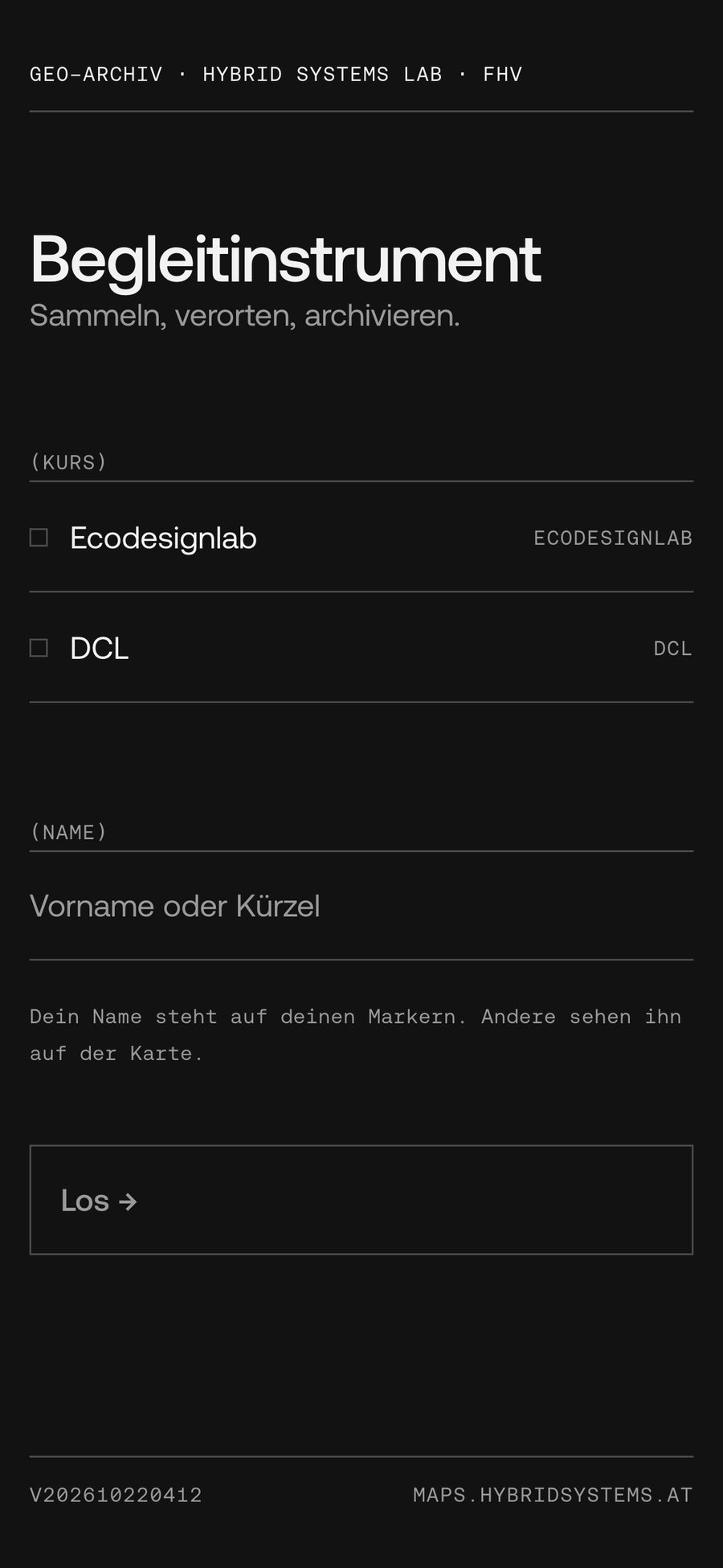
Begleitinstrument app · welcome
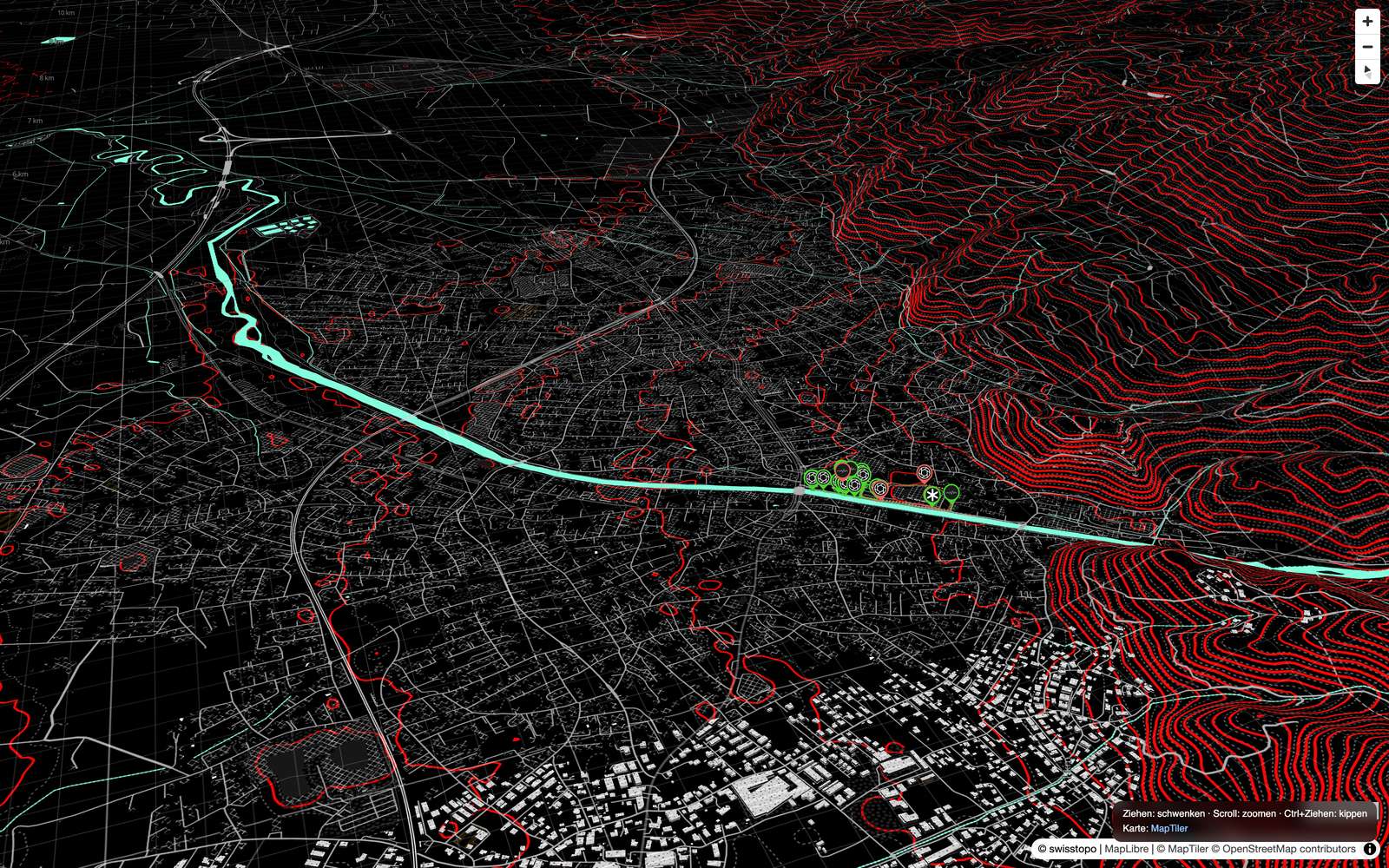
Course map · Dornbirn in 3D (08–09)
(08) the welcome view of the Begleitinstrument app — course selection and name, in the archive register. Source: app.hybridsystems.at (version v=202610220352) · captured 2026-10-22 · Playwright screenshot, phone viewport. The app builds on the Begleitinstrument developed by Andrijana Brkovic MA [S37].
(09) the Ecodesignlab course map over Dornbirn in 3D — terrain, contours, students' trails and markers on the same ground. Source: maps.hybridsystems.at/ecodesignlab · captured 2026-10-22 · Playwright screenshot of the live page (MapLibre 5, terrain). © swisstopo · © MapTiler © OpenStreetMap contributors.
(Chapter 08)Closing
a thirteenth thesis
Our manifesto has twelve theses. Thesis 01: „Die Karte ist das Argument.“ [verified] Thesis 07: „Lebendig, nicht fertig. Ein lebendiges Archiv bewahrt nur, was es ständig neu liest und bestreitet.“ [verified] Thesis 09: „Autorität entsteht aus nachvollziehbarem Prozess: Quelle, Datensatz, Datum, Methode in einer Mono-Zeile, immer.“ [verified] Thesis 10: „Mehr-als-menschliche Gegenwart. Arten, Biotope, Wasser, Seeboden sind Inhalt, nicht Hintergrund: …“ [verified] [S20]
We propose a thirteenth:
What we ask of designers, then, is small and concrete. Do not ship the 100 %. Print the 24 %. Put the thrush on the card — ours does not yet. Put the date of the bog on the splat. Label the run that failed its own test as a test. And keep the name of the person who walked there, because that is the one line no estimator can generate.
The crow is still on the map. If someone at the lake hears it again, the card will change. That is the whole method.
Jedes berechnete Bild ist eine Schätzung.Every computed image is an estimate.
Splat, Simulation, Modellvorhersage und Erinnerung sind dasselbe Objekt: eine gespeicherte Verteilung und eine Darstellung daraus. Wir zeigen die Verteilung mit: Konfidenz, Spannweite, Lücke. Was der Schätzer nicht gesehen hat – das Seltene, das Verschwindende –, trägt die Karte als Leerstelle und als menschliche Spur. Ein Bild ohne seine Schätzung ist ein Fenster; wir bauen Karten.
Splat, simulation, model prediction and memory are the same object: a stored distribution and a rendering of it. We show the distribution with the image — confidence, spread, gap. What the estimator did not see, the rare and the disappearing, the map carries as an empty field and as a human trace. An image without its estimate is a window; we build maps.
(Appendix A)
To destroy (my) nature. Notes toward human becoming (David Altweger, 2025)
Working notes, 2025 [S38]: a collection of quotations followed by short propositions of his own. Quotations below are given as checked by the quote audit of 2026-10-22, with its corrections applied; where the notes' wording differed from the source, the source wording is used.
- (01)
„Wir glauben, dass der Mensch in jeder Situation, unter jedem System, in jedem Staat die Aufgabe hat, Mensch zu sein und seinen Mitmenschen zur Verwirklichung des Menschseins zu helfen.“ [open for verification]
→ Ulrike Meinhof, attributed; written as a student, quoted after Wunderlich (secondary only, no primary text, year or page) [S47]
- (02)
„›Würde‹ ist die konditionale Form von dem, was einer ist.“ [verified]
→ Karl Kraus, Sprüche und Widersprüche (1909), VIII „Stimmungen, Worte“ [S48]
- (03)
“For apart from inquiry, apart from the praxis, individuals cannot be truly human. Knowledge emerges only through invention and re-invention, through the restless, impatient, continuing, hopeful inquiry human beings pursue in the world, with the world, and with each other.” [verified]
→ Paulo Freire, Pedagogy of the Oppressed, p. 72 [S40]
- (04)
“No one can be authentically human while he prevents others from being so.” [verified]
→ Paulo Freire, Pedagogy of the Oppressed, p. 85 [S40]
- (05)
“The pursuit of full humanity, however, cannot be carried out in isolation or individualism, but only in fellowship and solidarity; …” [verified]
→ Paulo Freire, Pedagogy of the Oppressed, p. 85 [S40]
- (06)
“There is no true word that is not at the same time a praxis. Thus, to speak a true word is to transform the world.” [verified]
→ Paulo Freire, Pedagogy of the Oppressed, p. 87 [S40]
- (07)
“The teacher is of course an artist, but being an artist does not mean that he or she can make the profile, can shape the students. What the educator does in teaching is to make it possible for the students to become themselves.” [verified]
→ Paulo Freire, in Myles Horton and Paulo Freire, We Make the Road by Walking (1990); page to confirm [open for verification] [S41]
- (08)
“If, in reality, I am not in the world simply to adapt to it, but rather to transform it, and if it is not possible to change the world without a certain dream or vision for it, I must make use of every possibility there is not only to speak about my utopia, but also to engage in practices consistent with it.” [verified]
→ Paulo Freire, Pedagogy of Indignation, “First Letter”; page to confirm [open for verification] [S42]
- (09)
“From the idea that the self is not given to us, I think that there is only one practical consequence: we have to create ourselves as a work of art.” [verified]
→ Michel Foucault, “On the Genealogy of Ethics”, in Ethics: Subjectivity and Truth, p. 262 [verified] [S43]
- (10)
„Mit der Menschenwürde wäre es nicht zu vereinbaren, wenn der Staat das Recht für sich in Anspruch nehmen könnte, den Menschen zwangsweise in seiner ganzen Persönlichkeit zu registrieren und zu katalogisieren, sei es auch in der Anonymität einer statistischen Erhebung, und ihn damit wie eine Sache zu behandeln, die einer Bestandsaufnahme in jeder Beziehung zugänglich ist.“ [verified]
→ BVerfG, 16 July 1969, 1 BvL 19/63, BVerfGE 27, 1 (6) – Mikrozensus [S39]
- (11)
‘Oh! Friend now quit thy learning, / One Alif is all thou dost need. / By learning thou hast loaded my mind, / With books thou hast filled up thy room. / But the true knowledge was lost by pursuing the false, / So quit now, oh friend, the pursuit of thy learning.’ [open for verification]
→ Bulleh Shah, song quoted by Inayat Khan in The Way of Illumination (The Sufi Message of Hazrat Inayat Khan, Vol. I) — not, as the notes have it, The Inner Life; wording as in the notes, line breaks restored [S44]
- (12)
“Anyone who's been deemed 'unnatural' in the face of reigning biological norms, anyone who's experienced injustices wrought in the name of natural order, will realize that the glorification of 'nature' has nothing to offer us–the queer and trans among us, the differently-abled, as well as those who have suffered discrimination due to pregnancy or duties connected to child-rearing. XF is vehemently anti-naturalist. Essentialist naturalism reeks of theology–the sooner it is exorcised, the better.” [verified]
→ Laboria Cuboniks, Xenofeminism: A Politics for Alienation (2015), §0x01 [S45]
- (13)
“Beauty, then, is a nonviolent experience of near death, a warning that one is fragile, like everything else in the universe.” [verified]
→ Timothy Morton, Realist Magic, p. 205 [S46]
- (14)
Kant, paraphrased in the notes as: things have a price (they can be exchanged), but persons have dignity (they are beyond price).
→ paraphrase of Immanuel Kant, Grundlegung zur Metaphysik der Sitten (1785), Ak. 4:434, which reads: „Im Reiche der Zwecke hat alles entweder einen Preis, oder eine Würde. Was einen Preis hat, an dessen Stelle kann auch etwas anderes als Äquivalent gesetzt werden; was dagegen über allen Preis erhaben ist, mithin kein Äquivalent verstattet, das hat eine Würde.“ [verified] [S49]
- (15)
“So we must try to make individuals more capable of agency, in order to amplify the dignity they enjoy as authors of their own lives.” [verified]
→ Matt McManus, “Kant's Theory of Human Dignity”, Philosophy Now 150 (2022) — unattributed in the notes [S52]
- (16)
“Indeed, taking human dignity seriously means organizing social and political contexts to amplify human agency to the greatest extent possible.” [open for verification]
→ follows the McManus sentence in the notes; probably the same source, not confirmed [S52]
(Notes)
Human becoming: constitutively social; the unfinishedness of humans and world; potentialities not always available to individual effort and choice; a historical possibility that may be socially enhanced or limited (hyper-becoming); it requires educating critical powers for reflection, praxis and social action.
Critical pedagogy is itself an example of its own message: consciousness demands a synthesis of transformative action and reflection in concrete situations — praxis. Critical education is a mutual transformation of teachers and students through concrete problem solving, the breaking down and re-constitution of given wholes, and sustained dialogues that create the conditions to change concrete realities and open new possibilities for action in our own personal and community processes of becoming.
Agency is not an all-or-nothing human trait but a degree of self-determination within relational becoming.
Agency belongs to any process that makes a difference in its unfolding relations, from microbes to ecosystems.
Dignity is not intrinsic to isolated individuals but emerges from being embedded in networks of life, matter and technology.
Agency: even annihilation is an act in which beings shape the world — their absence does something. The agency of a dying organism is in how it transforms others' possibilities.
Dignity: recognising dignity means honouring not only a being's flourishing but also its passing. Dignity in death, human or non-human, acknowledges that annihilation is part of a meaningful process, not mere negation.
(Sources)
Sources
Status of each quotation is given in the text. Pages are those of the edition named.
- [S1]Vilém Flusser, Für eine Philosophie der Fotografie. Göttingen: European Photography, 1983 (1st ed., 58 pp.); text reset 1989 (77 pp.); pages cited from a later printing of the 1989 text: S. 8, 9, 14. English: Towards a Philosophy of Photography, trans. Anthony Mathews. London: Reaktion Books, 2000, pp. 8, 10, 14, 15. https://reaktionbooks.co.uk/work/towards-a-philosophy-of-photography, accessed 2026-10-22. Note: thesis 02 of the manifesto cites „Flusser 1983, S. 8“ for the Landkarten sentence; it is S. 9 of the 1989 ff. printings.
- [S2]Vilém Flusser, Ins Universum der technischen Bilder. Göttingen: European Photography, 1985 (6th ed. 1999/2000: S. 14 „Übrig bleiben …“, quoted in Oliver Bruns, „Das ‚Ende der Politik‘ in der Kulturphilosophie Vilém Flussers“, Flusser Studies 09, 2009, p. 9, https://www.flusserstudies.net/sites/www.flusserstudies.net/files/media/attachments/bruns-ende-politik.pdf; 5th ed. 1996: S. 26 „unmöglich, Punkte zu Flächen zu ballen“, quoted in Melina Kirchartz, Riskantes Denken, Bielefeld: transcript, 2023, pp. 215–216 (2023, not 2022), https://www.transcript-verlag.de/shopMedia/openaccess/pdf/oa9783839466315.pdf; both accessed 2026-10-22). No primary copy of the German opened. English: Into the Universe of Technical Images, trans. Nancy Ann Roth. Minneapolis: University of Minnesota Press, 2011, pp. 10, 21, 33. ISBN 978-0-8166-7020-8.
- [S3]Bernhard Kerbl, Georgios Kopanas, Thomas Leimkühler, George Drettakis, “3D Gaussian Splatting for Real-Time Radiance Field Rendering.” ACM Transactions on Graphics 42(4), 2023. DOI 10.1145/3592433. Quoted from arXiv:2308.04079v1, pp. 1:4, 1:5, 1:10 (preprint pagination). https://arxiv.org/pdf/2308.04079, accessed 2026-10-22.
- [S4]ECMWF, Fact sheet: Ensemble weather forecasting. Reading: ECMWF, 2020, pp. 1–2. https://www.ecmwf.int/sites/default/files/medialibrary/2017-03/ecmwf-fact-sheet-ensemble-forecasting.pdf, accessed 2026-10-22.
- [S5]Frederic C. Bartlett, Remembering: A Study in Experimental and Social Psychology. Cambridge: Cambridge University Press, 1932 (reissued 1995, intro. W. Kintsch, original pagination), p. 213. https://archive.org/details/frederic-c.-bartlett-remembering-a-study-in-experimental-and-social-psychology-c, accessed 2026-10-22.
- [S6]Daniel L. Schacter, Donna Rose Addis, “The cognitive neuroscience of constructive memory: remembering the past and imagining the future.” Philosophical Transactions of the Royal Society B 362(1481), 2007a, 773–786, p. 773. DOI 10.1098/rstb.2007.2087. https://pmc.ncbi.nlm.nih.gov/articles/PMC2429996/, accessed 2026-10-22.
- [S7]Daniel L. Schacter, Donna Rose Addis, “The ghosts of past and future.” Nature 445(7123), 2007b, p. 27. DOI 10.1038/445027a. https://sites.harvard.edu/schacter-memory/files/2022/09/The-ghosts-of-past-and-future.pdf, accessed 2026-10-22.
- [S8]Elizabeth F. Loftus, John C. Palmer, “Reconstruction of automobile destruction: An example of the interaction between language and memory.” Journal of Verbal Learning and Verbal Behavior 13(5), 1974, 585–589, pp. 585, 588. DOI 10.1016/S0022-5371(74)80011-3. https://gwern.net/doc/psychology/cognitive-bias/1974-loftus.pdf, accessed 2026-10-22 (repost; check against the publisher version before print).
- [S9]Aleida Assmann, “Gedächtnis-Formen.” Bundeszentrale für politische Bildung, dossier “Geschichte und Erinnerung”, 26 August 2008. https://www.bpb.de/themen/erinnerung/geschichte-und-erinnerung/39786/gedaechtnis-formen/, accessed 2026-10-22.
- [S10]J. B. Harley, “Deconstructing the Map.” Cartographica 26(2), 1989, 1–20, pp. 7, 11, 14. DOI 10.3138/E635-7827-1757-9T53. Facsimile: http://www.comitepp.sp.gov.br/MESTRADO/files/Texto%2001%20-%20Harley%20A.pdf, accessed 2026-10-22 (repost; pagination = journal).
- [S11]Jeremy W. Crampton, John Krygier, “An Introduction to Critical Cartography.” ACME 4(1), 2005, 11–33, p. 15. https://acme-journal.org/index.php/acme/article/download/723/585/2396, accessed 2026-10-22.
- [S12]Nancy Lee Peluso, “Whose Woods Are These? Counter-Mapping Forest Territories in Kalimantan, Indonesia.” Antipode 27(4), 1995, 383–406, pp. 386–387. DOI 10.1111/j.1467-8330.1995.tb00286.x. https://terra-world.github.io/pdfs/peluso_whose_woods.pdf, accessed 2026-10-22 (repost).
- [S13]Grant Van Horn et al., “The iNaturalist Species Classification and Detection Dataset.” Proceedings of CVPR 2018, 8769–8778, p. 8769. https://openaccess.thecvf.com/content_cvpr_2018/papers/Van_Horn_The_INaturalist_Species_CVPR_2018_paper.pdf, accessed 2026-10-22.
- [S14]Vishaal Udandarao et al., “No 'Zero-Shot' Without Exponential Data: Pretraining Concept Frequency Determines Multimodal Model Performance.” NeurIPS 2024. arXiv:2404.04125v3, pp. 1, 7, 8. https://arxiv.org/pdf/2404.04125, accessed 2026-10-22.
- [S15]BirdNET-Analyzer documentation, “Segment review”, birdnet-team, GitHub, last changed 2025-06-30. https://github.com/birdnet-team/BirdNET-Analyzer/blob/main/docs/best-practices/segment-review.rst, accessed 2026-10-22. Model: Stefan Kahl, Connor M. Wood, Maximilian Eibl, Holger Klinck, “BirdNET: A deep learning solution for avian diversity monitoring.” Ecological Informatics 61, 2021, 101236. DOI 10.1016/j.ecoinf.2021.101236.
- [S16]Ivar Puura, “Nature in our memory.” Sign Systems Studies 41(1), 2013, 150–153, p. 152. DOI 10.12697/SSS.2013.41.1.10. https://ojs.utlib.ee/index.php/sss/article/download/SSS.2013.41.1.10/10741/15970, accessed 2026-10-22.
- [S17]Margarita Köhl, David Altweger, “Sphagnum Dances – Merging with Mosses: Vegetal agency in distributed more-than-human choreographies.” Extended Abstracts of the Expanded Animation Conference on Animation and Interactive Art (Expanded '24), September 5–7, Linz, Austria, 3 pages. Zenodo DOI 10.5281/zenodo.12792880, CC BY 4.0. https://zenodo.org/records/12792880, accessed 2026-10-22. Award: see [S51]. David Altweger is listed as a SPARKS presenter on the SIGGRAPH Digital Arts Community site (a presenter role, not an award): https://dac.siggraph.org/person/david-altweger/, accessed 2026-10-22.
- [S18]Margarita Marie Köhl, David Emanuel Altweger, “Doubleblind. Sensibilities of Extinction: Inducing commemorative practices of countermapping and distributed archiving in an extended reality (XR) environment.” Expanded 2026: Conference on Animation and Interactive Art (Expanded 2026), September 09–11, 2026, Linz, Austria. ACM, 4 pages; quoted pp. 1, 3. CC BY-NC-ND 4.0. ISBN 979-8-4007-2865-5. DOI 10.1145/3840416.3840465 (not resolving on 2026-10-22). Programme: https://expanded-conf.org/program/, accessed 2026-10-22.
- [S19]David Altweger [and Margarita Köhl — authorship to confirm], “Werkbeschreibung: Sphagnum Dances – Werde Moor”, as of 28 August 2026 (version in the inatura submission package). Unpublished.
- [S20]Hybride Systeme — Manifest (12 theses). design.hybridsystems.at, 21 October 2026. https://design.hybridsystems.at/, accessed 2026-10-22.
- [S21]Achille Mbembe, Necropolitics, trans. Steven Corcoran. Durham: Duke University Press, 2019 (orig. Politiques de l'inimitié, La Découverte, 2016), pp. 92, 107, 172. https://dukeupress.edu/necropolitics, accessed 2026-10-22.
- [S22]Achille Mbembe, Brutalism, trans. Steven Corcoran. Durham: Duke University Press, 2024 (orig. Brutalisme, La Découverte, 2020), pp. 7, 8, 40, 41, 44. https://dukeupress.edu/brutalism, accessed 2026-10-22.
- [S23]Hybrid Systems Lab, “Lab morning brief, Thu 2026-10-22”, compiled by the coordinating Mac session from the lab dashboard feed, 04:15 CEST. Unpublished. The lake model's bathymetry source, name and solver are not stated in it.
- [S24]Achille Mbembe, “The Earthly Community.” Holberg Lecture, Bergen, 5 June 2024. https://holbergprisen.no/nyheter/holbergforelesningen-2024-av-achille-mbembe/, accessed 2026-10-22.
- [S25]Achille Mbembe, “The Universal Right to Breathe,” trans. Carolyn Shread. Critical Inquiry blog “In the Moment”, 13 April 2020. https://critinq.wordpress.com/2020/04/13/the-universal-right-to-breathe/, accessed 2026-10-22.
- [S26]tofukoma, “Project.” https://www.tofukoma.com/project, accessed 2026-10-22.
- [S27]Hybrid Systems Lab, mapping project records (session log 6–22 October 2026); audio marker
david_2026-10-07_direct_2026-10-07T08-15-28-552Z_001,properties.birdnet. https://maps.hybridsystems.at/geojson/all_audios.geojson, accessed 2026-10-22. - [S28]Margarita Köhl, David Altweger [co-authorship to confirm], Hybrid Systems Lab & Toolbox. Unpublished, 20 October 2026: part “Hybrid Systems Lab”, paragraph 1; part “Toolbox für Workshopformate”, paragraphs 2 and 5.
- [S29]David Altweger, “Learning as a Collective Journey.” Philosophical essay, pedagogy module, PGCert, Middlesex University, 2020. Unpublished. [open for verification]
- [S30]John Dewey, The Child and the Curriculum. Chicago: University of Chicago Press, 1902, pp. 19–21. https://archive.org/details/childandcurricul00deweuoft, accessed 2026-10-22. (The essay [S29] attributes the explorer passage to Democracy and Education, 1916, p. 160; it is not there — see [S53].)
- [S31]John Dewey, Experience and Education. New York: Macmillan, 1938. Cited in [S29]; not quoted here. [open for verification]
- [S32]John Kitchens, “Situated Pedagogy and the Situationist International: Countering a Pedagogy of Placelessness.” Educational Studies 45(3), 2009, 240–261, p. 240 (abstract). DOI 10.1080/00131940902910958. (Kitchens was at Whitman College; the essay's in-text “Whitman, 2009, p1(77)” refers to him.)
- [S33]John Dewey, “My Pedagogic Creed.” The School Journal LIV(3), 16 January 1897, 77–80, Art. V. https://web.archive.org/web/20200930095916/https://infed.org/mobi/john-dewey-my-pedagogical-creed/, accessed 2026-10-22 (the essay's original infed.org link returns 404). Cited in [S29]; not quoted here.
- [S34]Thomas C. Reeves, Jan Herrington, Ron Oliver, “A development research agenda for online collaborative learning.” Educational Technology Research and Development 52(4), 2004, 53–65. DOI 10.1007/BF02504718. Cited in [S29]; not quoted here.
- [S35]Michael F. Mascolo, Kurt W. Fischer, “Constructivist theories.” In B. Hopkins (ed.), The Cambridge Encyclopedia of Child Development. Cambridge: Cambridge University Press, 2005, 49–63. Cited in [S29]; quotation there unverified; not quoted here. [open for verification]
- [S36]Linda Harasim, Learning Theory and Online Technologies. New York: Routledge, 2012, p. 81. DOI 10.4324/9780203846933. (Cited in [S29] as “Harasim, 2011” with wording that differs from the book.) Not quoted here.
- [S37]Andrijana Brkovic, master thesis on the Begleitinstrument [title to be added], [institution and year to be added]. [open for verification]
- [S38]David Altweger, “To destroy (my) nature” — working notes on human becoming, 2025 (document created 19 June 2025, last modified 5 September 2025). Unpublished.
- [S39]BVerfG, Beschluss vom 16. Juli 1969, 1 BvL 19/63, BVerfGE 27, 1 (6) – Mikrozensus. https://www.servat.unibe.ch/dfr/bv027001.html, accessed 2026-10-22.
- [S40]Paulo Freire, Pedagogy of the Oppressed. 30th-anniversary ed., trans. Myra Bergman Ramos. New York: Continuum, 2000, pp. 72, 85, 87. https://archive.org/details/freire-pedagogy-of-the-oppressed, accessed 2026-10-22.
- [S41]Myles Horton, Paulo Freire, We Make the Road by Walking: Conversations on Education and Social Change, ed. Brenda Bell, John Gaventa, John Peters. Philadelphia: Temple University Press, 1990 [page to confirm]. [open for verification]
- [S42]Paulo Freire, Pedagogy of Indignation. Boulder: Paradigm, 2004, “First Letter” [page to confirm]. [open for verification]
- [S43]Michel Foucault, “On the Genealogy of Ethics: An Overview of Work in Progress.” In Paul Rabinow (ed.), Ethics: Subjectivity and Truth. New York: New Press, 1997, p. 262 (orig. in Dreyfus & Rabinow, Michel Foucault: Beyond Structuralism and Hermeneutics, 2nd ed., Chicago: University of Chicago Press, 1983).
- [S44]Bulleh Shah, song quoted in Inayat Khan, The Way of Illumination, in The Sufi Message of Hazrat Inayat Khan, Vol. I [1979 ed., pp. 40–41, to confirm]. https://wahiduddin.net/mv2/I/I_I_2.htm, accessed 2026-10-22. [open for verification]
- [S45]Laboria Cuboniks, Xenofeminism: A Politics for Alienation, 2015, §0x01. https://laboriacuboniks.net/manifesto/xenofeminism-a-politics-for-alienation/, accessed 2026-10-22.
- [S46]Timothy Morton, Realist Magic: Objects, Ontology, Causality. Ann Arbor: Open Humanities Press, 2013, p. 205. http://openhumanitiespress.org/books/download/Morton_2013_Realist-Magic.pdf, accessed 2026-10-22.
- [S47]Ulrike Meinhof, attributed; quoted after Dieter Wunderlich, “Ulrike Meinhof.” https://www.dieterwunderlich.de/Meinhof.htm, accessed 2026-10-22 (secondary only). [open for verification]
- [S48]Karl Kraus, Sprüche und Widersprüche. München: Langen, 1909, VIII “Stimmungen, Worte”. https://textlog.de/39294.html, accessed 2026-10-22.
- [S49]Immanuel Kant, Grundlegung zur Metaphysik der Sitten, 1785, Ak. 4:434. https://korpora.org/Kant/aa04/434.html, accessed 2026-10-22.
- [S50]David Altweger, online course environment on Miro, 2020. https://miro.com/app/board/o9J_kqxM1Us=/ (link from [S29]; responded on 2026-10-22, content not checked). [open for verification]
- [S51]FHV Magazine, “Award for Best Paper at Ars Electronica Festival”, 16 September 2024. https://www.fhv.at/en/magazine/auszeichnung-fur-best-paper-bei-ars-electronica-festival-19212, accessed 2026-10-22 (page wording: “They received the "Best Paper" award for their work.”). The qualifier “Art Track” is from the award certificate held by the authors.
- [S52]Matt McManus, “Kant's Theory of Human Dignity.” Philosophy Now 150, 2022. https://philosophynow.org/issues/150/Kants_Theory_of_Human_Dignity, accessed 2026-10-22.
- [S53]John Dewey, Democracy and Education. New York: Macmillan, 1916. https://www.gutenberg.org/ebooks/852, accessed 2026-10-22. Cited in [S29] (1961 printing, p. 160) for the explorer passage, which the book does not contain; not quoted here.
- [S54]Jan Herrington, Ron Oliver, Thomas C. Reeves, “Patterns of engagement in authentic online learning environments.” Australasian Journal of Educational Technology 19(1), 2003, 59–71. DOI 10.14742/ajet.1701. https://ajet.org.au/index.php/AJET/article/view/1701, accessed 2026-10-22. Cited in [S29]; the sentence attributed to it there is from [S34]. Not quoted here.
- [S55]FHV, “Design Symposium: Hybrid Futures – Design Beyond Transformation”, Friday 6 November 2026. https://www.fhv.at/fh/die-fhv/events/designsymposium, accessed 2026-10-22.
(Could not verify)
- Flusser, Ins Universum der technischen Bilder: no primary copy of the German opened; the two German passages rest on Bruns 2009 and Kirchartz 2023.
- The essay's two map sentences attributed to Dewey (“The map records only the relationships …”; “… is to give the results of an experience …”) are in neither Dewey 1902 nor 1916 and have no traceable source; they are not quoted in this article.
- The two sentences quoted from the 2020 essay itself and the Miro board: not yet checked by the audit.
- Meinhof (secondary only); Bulleh Shah / Inayat Khan pages and punctuation; Horton & Freire and Pedagogy of Indignation pages; the second McManus sentence; Mascolo & Fischer.
- The lake model's bathymetry source, solver and configuration are not named in any document available on 2026-10-22.
- Secondary reposts used for Loftus & Palmer, Harley and Peluso: check the publisher versions before anything goes to print.
- Andrijana Brkovic's thesis title, institution and year.
(Kapitel 00)Eröffnung
Die Krähe bei 24 %
Am 7. Oktober 2026 um 10:20 stand einer von uns am Yachthafen in Bregenz, 47,5294° N, 9,7410° O, und nahm mit einem Mobiltelefon 66 Sekunden Ton auf. Die Aufnahme kam als Marker in unser Kursarchiv. Zwei Wochen später hörte ein Vogelmodell sie ab.
Das Modell, BirdNET 2.4, erwartete für diesen Ort und diese Woche 120 Arten. Es fand genau eines: zwischen Sekunde 6 und Sekunde 9 eine Rabenkrähe, mit einer Konfidenz von 0,241. Daneben eine Nebelkrähe mit 0,152; unter unserer Anzeigeschwelle, später in der Aufnahme, eine Singdrossel mit 0,113. Die Drossel steht im Datensatz; die Archivkarte zeigt nur die beiden Krähen. [S27]
Auf der Archivkarte steht „Rabenkrähe Corvus corone · 24 %“ [verifiziert]. Darunter, in der kleinen Mono-Zeile: „Arterkennung: BirdNET 2.4 (Cornell Lab of Ornithology & TU Chemnitz) · automatische Schätzung, nicht verifiziert“ [verifiziert]. Um diese Zeile geht es in diesem Text.
Die Dokumentation von BirdNET sagt selbst, was die Zahl nicht ist: “BirdNET confidence values are not probabilities but a measure of the algorithm's prediction reliability.” [verifiziert] [„Die Konfidenzwerte von BirdNET sind keine Wahrscheinlichkeiten, sondern ein Maß für die Verlässlichkeit der Vorhersage des Algorithmus.“ (Übers. tofukoma/Claude)] Die Archivkarte sagt also nicht, dass dort eine Krähe war. Sie sagt: Ein Schätzer, trainiert vor allem mit Aufnahmen von anderswo, hat diesen Klang gelesen und neigt zu 24 % zur Krähe. [S15]
Das ist ein ehrliches Bild. Wir behaupten: Die meisten Bilder, mit denen wir heute leben, sind von dieser Art – und die meisten verbergen ihre 24 %.
Faltkarte A3 · Marker Nr. 0002 · Seite 1 (01)
die Faltkarte des Krähen-Markers in A3, Vorderseite (Seite 1, mittiger 16:10-Ausschnitt) – Falzseiten Feld | Info | Labor zu 140 × 297 mm, der Vektorkartenausschnitt in 1 : 2 300, die Mono-Quellenzeile in Lesegröße gedruckt. Die Faltkarte ist der Apparat, mit dem Bild gedruckt. Quelle: Druckstrecke /api/print/<marker_id>?format=a3 auf dem Laborserver (Vektorkarte aus MapTiler-Kacheln, PDF über Chromium) · erzeugt 2026-10-22 · als Bild ausgegebene PDF-Seite 1. © MapTiler © OpenStreetMap contributors; BirdNET 2.4 (Cornell Lab of Ornithology & TU Chemnitz).
Archivkarte, Info-Seite · Artzeilen (02)
Info-Seite der Archivkarte, Artzeilen und Herkunftszeile, beschnitten. Quelle: maps.hybridsystems.at/ecodesignlab · aufgenommen 2026-10-22 · Playwright-Bildschirmaufnahme des Kartenelements.
(Kapitel 01)Flusser · Gaussian Splatting
Ein technisches Bild ist eine Karte
1983 schreibt Vilém Flusser in Für eine Philosophie der Fotografie: „Bilder sind bedeutende Flächen“ (Flusser [1983] 1989 ff., S. 8; Reaktion 2000, S. 8) [verifiziert]. Sie vermitteln zwischen der Welt und uns, und dann: „Sie sollen Landkarten sein und werden zu Wandschirmen: Statt die Welt vorzustellen, verstellen sie sie …“ (S. 9; Reaktion S. 10) [verifiziert]. [S1]
Das technische Bild, das von Apparaten erzeugte Bild, verschärft das. “Ontologically, traditional images signify phenomena whereas technical images signify concepts.” (Reaktion 2000, S. 14) [verifiziert] [„Ontologisch bedeuten traditionelle Bilder Phänomene, technische Bilder dagegen Begriffe.“ (Übers. tofukoma/Claude)] Und: “apparently non-symbolic, objective character […] leads whoever looks at them to see them not as images but as windows.” (S. 15; im Deutschen: „nicht als Bilder, sondern als Fenster anzusehen“, S. 14) [verifiziert] [„scheinbar nicht-symbolischer, objektiver Charakter […] führt dazu, dass, wer sie betrachtet, sie nicht als Bilder, sondern als Fenster ansieht.“ (Übers. tofukoma/Claude)] [S1]
In Ins Universum der technischen Bilder (1985) sagt Flusser, wie ein solches Bild gebaut ist: gerechnet, nicht gezeichnet. „Übrig bleiben dimensionslose Punktelemente, die weder faßbar noch vorstellbar, noch begreifbar sind – unzugänglich für Hände, Augen und Finger. Aber sie sind kalkulierbar (‚calculus‘ = Steinchen) und können mittels spezieller, mit Tasten versehener Apparate gerafft (‚komputiert‘) werden. Man kann diese mit Fingerspitzen auf Apparat-Tasten drückende Geste ‚Kalkulieren und Komputieren‘ nennen. Dank ihr entstehen mosaikartige Raffungen von Punktelementen: die technischen Bilder. Ein komputiertes Universum, in welchem Punktelemente zu scheinbaren Bildern eingebildet werden.“ (Flusser [1985] 1999, S. 14, zit. n. Bruns 2009, S. 9) [offen zur Prüfung] [S2]
Nancy Ann Roths englische Übersetzung schreibt für Punktelemente meist “particles” („Teilchen“, 2011, S. 10) [verifiziert]; das Wort „Punkt“ verschwindet dabei meist. Darum lesen wir das Deutsche.
Flusser weiß, dass die Fläche eine Fiktion ist: „ist es unmöglich, Punkte zu Flächen zu ballen. Da jede Fläche aus unendlich vielen Punkten zusammengesetzt ist, wären unendlich viele Punkte zu raffen, um tatsächliche Flächen herzustellen.“ (Flusser [1985] 1996, S. 26, zit. n. Kirchartz 2023, S. 215 f.) [offen zur Prüfung] In Roths Englisch: “Therefore the envisioner can produce only a virtual image, that is, a surface full of intervals, like a raster. The envisioner must be content with the appearance of surface, with trompe l'oeil.” (Roth, S. 21) [verifiziert] [„Der Einbildende kann daher nur ein virtuelles Bild herstellen, das heißt eine Fläche voller Intervalle, wie ein Raster. Der Einbildende muss sich mit dem Anschein von Fläche begnügen, mit dem Trompe-l’Œil.“ (Übers. tofukoma/Claude)] Und der Satz, der es zusammenfasst: “on close inspection, they all prove to be envisioned surfaces computed from particles.” (Roth, S. 33) [verifiziert] [„bei genauem Hinsehen erweisen sich alle als eingebildete, aus Teilchen komputierte Flächen.“ (Übers. tofukoma/Claude)] [S2]
2023 veröffentlichten Kerbl, Kopanas, Leimkühler und Drettakis 3D Gaussian Splatting. Ihr Ausgangsmaterial ist “a set of images of a static scene, together with the corresponding cameras calibrated by SfM […] which produces a sparse point cloud as a side-effect. From these points we create a set of 3D Gaussians […], defined by a position (mean), covariance matrix and opacity α” (Kerbl et al. 2023, arXiv v1, S. 1:4) [verifiziert] [„eine Reihe von Bildern einer statischen Szene, zusammen mit den zugehörigen, per SfM kalibrierten Kameras […], was als Nebenprodukt eine dünne Punktwolke erzeugt. Aus diesen Punkten erzeugen wir eine Menge von 3D-Gaußverteilungen […], bestimmt durch eine Position (Mittelwert), eine Kovarianzmatrix und eine Opazität α“ (Übers. tofukoma/Claude)]. [S3]
Ein Splat ist also kein Foto des Mooses. Er ist eine Wolke kleiner Wahrscheinlichkeitsverteilungen, jede mit Mittelwert und Kovarianz, so lange umgeformt, bis die Wolke unsere Fotos wiedergibt. Jede daraus berechnete Ansicht ist ein Schluss – oft von einer Kameraposition aus, an der nie ein Foto entstand.
Der Aufsatz benennt auch, wo die Methode bricht: “our optimization can get stuck with floaters close to the input cameras” (S. 1:5) [verifiziert] [„unsere Optimierung kann nahe den Eingabekameras an Schwebeartefakten hängen bleiben“ (Übers. tofukoma/Claude)]; “In regions where the scene is not well observed we have artifacts” [verifiziert] [„In Bereichen, in denen die Szene schlecht beobachtet ist, entstehen Artefakte“ (Übers. tofukoma/Claude)], und die Methode “can create elongated artifacts or 'splotchy' Gaussians” (S. 1:10) [verifiziert] [„kann langgezogene Artefakte oder ‚fleckige‘ Gaußverteilungen erzeugen“ (Übers. tofukoma/Claude)]. Schwebeartefakte, Flecken, langgezogene Gaußverteilungen: Das tut der Schätzer dort, wo man ihm zu wenig gezeigt hat. [S3]
Das ist Flussers Gedanke, wörtlich genommen: eine “surface full of intervals, like a raster” [verifiziert] [„Fläche voller Intervalle, wie ein Raster“ (Übers. tofukoma/Claude)], von einem Apparat mit Tasten aus Punktelementen gerafft, vierzig Jahre vor dem Aufsatz. Er bedeutet Begriffe – Mittelwerte, Kovarianzen – und zeigt uns ein Fenster. Ein Splat eines Sphagnum-Polsters aus unserem Mooslabor sieht aus wie das Polster. Er ist eine Karte der Fotos, die wir hatten; die Lücken füllt die Vorannahme der Methode.
Vektorkartenausschnitt · Marker 0002 · 1 : 2 300 (03)
der Vektorkartenausschnitt um den Krähen-Marker, aus Kacheln gebaut, nicht aus einer Bildschirmaufnahme – eine SVG-Gruppe pro Ebene (MapTiler-v4-Vektorkacheln, MapTiler-Höhenlinien, Kursebenen), Maßstab 1 : 2 300. Quelle: Druckstrecke mapsvg.mjs auf dem Laborserver, Marker david/0002 · erzeugt 2026-10-22 (SVG-Metadaten) · © MapTiler © OpenStreetMap contributors.
(Kapitel 02)Seemodell · Ensembles
Simulationen, in der Zeit gerechnet
Unser zweiter Kurs, die Design Challenge, arbeitet mit einem numerischen Modell des Bodensees: einer Bathymetrie, einem Antrieb aus Wind und Zuflüssen und einem Löser, der das Wasser auf vier Laborrechnern durch die Zeit bewegt. Alle dreiundzwanzig bis fünfundvierzig Minuten schreibt er ein Bild. [S23]
Diese Woche sind die Läufe an ihrem eigenen Test gescheitert. Der Morgenbericht unseres Labors, zusammengestellt aus dem Laufprotokoll vom 21. und 22. Oktober: “MOUTHS FAIL 31 rows (Alpenrhein M3 M4, Argen M2, Bregenzer M5, nine small rivers M1–M3) and drift FAIL (15 m median swing 38°)” [verifiziert] [„MÜNDUNGEN NICHT BESTANDEN, 31 Zeilen (Alpenrhein M3 M4, Argen M2, Bregenzer M5, neun kleine Flüsse M1–M3), und Drift NICHT BESTANDEN (15 m, mediane Schwenkung 38°)“ (Übers. tofukoma/Claude)]. Und: “The Rhine still turns right (+61.5°), so the wedge cut did not remove the T127 turn.” [verifiziert] [„Der Rhein dreht weiter nach rechts (+61,5°), der Keilschnitt hat die Drehung bei T127 also nicht beseitigt.“ (Übers. tofukoma/Claude)] Die Empfehlung des Berichts für den Tag: “Present them as tests, not as validated results.” [verifiziert] [„Zeigt sie als Tests, nicht als validierte Ergebnisse.“ (Übers. tofukoma/Claude)] [S23]
Eine Flussmündung, die sich in die falsche Richtung dreht, ist ein Schwebeartefakt in einem anderen Medium. Sie überzeugt das Auge – Wasser fließt, Fahnen breiten sich aus, das Bild sieht aus wie Beobachtung. Und sie ist ein Artefakt des Schätzers: des Rechengitters, der Randbedingung, des Keils, den jemand in die Bathymetrie geschnitten hat, damit sich der Zufluss fügt.
Wetterdienste leben seit Langem damit. Das ECMWF über sein Ensemble: “Multiple simulations are run, each with a slight variation of its initial conditions and with slightly perturbed weather models. These variations represent the inevitable uncertainty in the initial conditions and approximations in the models.” (S. 1) [verifiziert] [„Es werden mehrere Simulationen gerechnet, jede mit einer leichten Variation ihrer Anfangsbedingungen und mit leicht gestörten Wettermodellen. Diese Variationen bilden die unvermeidliche Unsicherheit der Anfangsbedingungen und die Näherungen in den Modellen ab.“ (Übers. tofukoma/Claude)] Und: “Single 'deterministic' forecasts can be misleading” (S. 1) [verifiziert] [„Einzelne ‚deterministische‘ Vorhersagen können irreführen“ (Übers. tofukoma/Claude)]. [S4]
Das Ensemble ist die ehrliche Form des simulierten Bildes: nicht ein Bild, sondern einundfünfzig (S. 2) [verifiziert], und die Streuung zwischen ihnen gehört zum Inhalt. Ein einzelner überzeugender Lauf des Sees ist ein Fenster. Die Streuung ist die Karte.
Seeboden · Perspektive, Neigung 62° (04)
der Grund des Bodensees als Gelände, das Wasser durchsichtig gemacht. Quelle: VOGIS-Tiefenmodell (tiefenmodell 1 m, 2014, © Land Vorarlberg) über WCS, im Browser in MapTiler terrain-rgb-v2 eingerechnet (merge-dem), mit aufgelegter Schummerung und Tiefenfärbung; Editor geobridge.hybridsystems.at · aufgenommen 2026-10-22 · Playwright-Bildschirmaufnahme des laufenden Editors. Das ist das Seegrund-Gelände des Editors, nicht das Eingangsmaterial der Simulation des Labors. © MapTiler © OpenStreetMap contributors.
Seeboden · Draufsicht (05)
dasselbe Seegrund-Gelände in Draufsicht, Tiefenlinien (VOGIS) als Vektorkacheln. Quelle und Verfahren wie 03 · aufgenommen 2026-10-22.
(Kapitel 03)Bartlett · Schacter · Loftus · Assmann
Auch Erinnerung ist eine Schätzung
Wir halten das menschliche Gedächtnis gern der Maschine entgegen, als das Warme und Wahre. Die Psychologie sagt seit neunzig Jahren etwas anderes. Frederic Bartlett, 1932: “Remembering is not the re-excitation of innumerable fixed, lifeless and fragmentary traces. It is an imaginative reconstruction, or construction, built out of the relation of our attitude towards a whole active mass of organised past reactions or experience, and to a little outstanding detail which commonly appears in image or in language form.” (Bartlett 1932, S. 213) [verifiziert] [„Erinnern ist nicht die Wiedererregung unzähliger fester, lebloser und bruchstückhafter Spuren. Es ist eine imaginative Rekonstruktion oder Konstruktion, gebaut aus dem Verhältnis unserer Haltung zu einer ganzen aktiven Masse organisierter vergangener Reaktionen oder Erfahrungen und zu einem kleinen hervorstechenden Detail, das gewöhnlich als Bild oder in sprachlicher Form erscheint.“ (Übers. tofukoma/Claude)] [S5]
- “It is an imaginative reconstruction, or construction”— Bartlett 1932, S. 213 [verifiziert] · „Es ist eine imaginative Rekonstruktion oder Konstruktion“ (Übers. tofukoma/Claude)
Schacter und Addis, 2007a: Das episodische Gedächtnis ist “a fundamentally constructive, rather than reproductive, process that is prone to various kinds of errors and illusions” (S. 773) [verifiziert] [„ein grundlegend konstruktiver, nicht reproduktiver Prozess, der für verschiedene Arten von Fehlern und Täuschungen anfällig ist“ (Übers. tofukoma/Claude)]. Erinnerung wird aus Stücken gebaut, um die Zukunft zu simulieren: “A memory that works by piecing together bits of the past may be better suited to simulating future events than one that is a store of perfect records.” (Schacter & Addis 2007b, S. 27) [verifiziert] [„Ein Gedächtnis, das Stücke der Vergangenheit zusammensetzt, eignet sich womöglich besser, künftige Ereignisse zu simulieren, als eines, das ein Speicher vollkommener Aufzeichnungen ist.“ (Übers. tofukoma/Claude)] [S6] [S7]
Elizabeth Loftus wies nach, wie die Stücke vertauscht werden. 1974 zeigten sie und John Palmer Versuchspersonen den Film eines Autounfalls. Sie fragten, wie schnell die Autos fuhren, als sie ineinander “smashed” (krachten) oder einander “hit” (trafen). Eine Woche später: “those subjects who received the verb smashed were more likely to say 'yes' to the question, 'Did you see any broken glass?', even though broken glass was not present in the film.” (Loftus & Palmer 1974, S. 585) [verifiziert] [„Versuchspersonen, die das Verb smashed erhalten hatten, antworteten eher mit ‚Ja‘ auf die Frage ‚Haben Sie zerbrochenes Glas gesehen?‘, obwohl im Film kein zerbrochenes Glas vorkam.“ (Übers. tofukoma/Claude)] Und: “All we have is one 'memory.'” (S. 588) [verifiziert] [„Alles, was wir haben, ist eine ‚Erinnerung‘.“ (Übers. tofukoma/Claude)] [S8]
Stellen Sie die drei nebeneinander. Eine Erinnerung ist eine gespeicherte Verteilung plus eine Darstellung im Moment des Abrufs, und die nimmt, was gerade zur Hand ist – das Wort eines Anwalts, ein später gesehenes Foto. Ein Splat ist dasselbe im Moment der Ansicht, dargestellt durch die Vorannahme der Methode; eine Vorhersage dasselbe im Moment des Laufs. Die ehrlichen Fassungen tragen ihre Unsicherheit mit – eine Gaußverteilung ihre Kovarianz, ein Ensemble seine Streuung, eine Erinnerung ihren gefühlten Zweifel. Die unehrlichen verbergen sie.
Aleida Assmann gibt der Seite des Archivs ihr Vokabular. Das kulturelle Gedächtnis hat „ein Speichergedächtnis und ein Funktionsgedächtnis. Das Speichergedächtnis sammelt und bewahrt Quellen, Objekte und Daten, unabhängig davon, ob sie von der Gegenwart gebraucht werden […]. Das Funktionsgedächtnis ist demgegenüber ein aktives Gedächtnis“ (Assmann 2008) [verifiziert]. Das Funktionsgedächtnis ist die kleine, aktive Auswahl, die eine Gesellschaft wieder gegenwärtig macht. [S9]
(Kapitel 04)Harley · Peluso · die Ausläufer
Jede Karte hat ihr Schweigen
Brian Harley, 1989, in Deconstructing the Map: “Much of the power of the map, as a representation of social geography, is that it operates behind a mask of a seemingly neutral science.” (S. 7) [verifiziert] [„Ein großer Teil der Macht der Karte als Darstellung sozialer Geografie liegt darin, dass sie hinter der Maske einer scheinbar neutralen Wissenschaft wirkt.“ (Übers. tofukoma/Claude)] “The steps in making a map – selection, omission, simplification, classification, the creation of hierarchies, and 'symbolization' – are all inherently rhetorical.” (S. 11) [verifiziert] [„Die Schritte der Kartenherstellung – Auswahl, Weglassung, Vereinfachung, Klassifikation, die Bildung von Hierarchien und ‚Symbolisierung‘ – sind allesamt ihrem Wesen nach rhetorisch.“ (Übers. tofukoma/Claude)] Und: “the map is never neutral.” (S. 14) [verifiziert] [„die Karte ist nie neutral.“ (Übers. tofukoma/Claude)] [S10]
- “the map is never neutral.”— Harley 1989, S. 14 [verifiziert] · „die Karte ist nie neutral.“ (Übers. tofukoma/Claude)
Nancy Peluso, deren Gegenkartierung im Titel unseres Expanded-Beitrags steht, schrieb 1995 über Kalimantan: “Alternative maps, or 'counter-maps' as I call them here, greatly increase the power of people living in a mapped area to control representations of themselves and their claims to resources” (S. 386–387) [verifiziert] [„Alternative Karten oder ‚Gegenkarten‘, wie ich sie hier nenne, stärken erheblich die Macht der Menschen, die in einem kartierten Gebiet leben, über die Darstellung ihrer selbst und ihrer Ansprüche auf Ressourcen zu bestimmen“ (Übers. tofukoma/Claude)]. [S12] Jeremy Crampton und John Krygier: “Maps are active; they actively construct knowledge, they exercise power” (2005, S. 15) [verifiziert] [„Karten sind aktiv; sie konstruieren aktiv Wissen, sie üben Macht aus“ (Übers. tofukoma/Claude)]. [S11]
Lesen Sie nun Harleys Liste – Auswahl, Weglassung, Vereinfachung, Klassifikation – als Beschreibung eines trainierten Modells. Ein Schätzer gibt die Mitte seiner Trainingsverteilung wieder und unterdrückt ihre Ausläufer. Das ist kein Fehler; genau das heißt Anpassen. Das Schweigen einer handgezeichneten Karte sind die Entscheidungen der Kartografin, des Kartografen. Das Schweigen eines Schätzers ist die Form seiner Daten.
Die Daten sind nicht gleich verteilt. Der Aufsatz zum iNaturalist-Datensatz von 2018: “the natural world is heavily imbalanced, as some species are more abundant and easier to photograph than others.” [verifiziert] [„die natürliche Welt ist stark unausgewogen, da manche Arten häufiger und leichter zu fotografieren sind als andere.“ (Übers. tofukoma/Claude)] Und: “we observe poor results for classes with small numbers of training examples” (Van Horn et al. 2018, S. 8769) [verifiziert] [„wir beobachten schlechte Ergebnisse bei Klassen mit wenigen Trainingsbeispielen“ (Übers. tofukoma/Claude)]. [S13]
Udandarao et al. haben das 2024 für die großen multimodalen Modelle gemessen: Sie “require exponentially more data to achieve linear improvements in downstream 'zero-shot' performance” (S. 1) [verifiziert] [„benötigen exponentiell mehr Daten, um lineare Verbesserungen der nachgelagerten ‚Zero-Shot‘-Leistung zu erreichen“ (Übers. tofukoma/Claude)], und ihre Trainingsdaten haben “an extremely long-tailed distribution of concept frequencies […], with over two-thirds of concepts occurring at almost negligible frequencies” (S. 7) [verifiziert] [„eine extrem langschwänzige Verteilung der Begriffshäufigkeiten […], wobei über zwei Drittel der Begriffe mit nahezu vernachlässigbarer Häufigkeit vorkommen“ (Übers. tofukoma/Claude)]. Unter den seltensten Begriffen: “eggnog, wormsnake, and tropical kingbird” (S. 8) [verifiziert] [„Eierpunsch, Wurmnatter und Trauerkönigstyrann“ (Übers. tofukoma/Claude)]. [S14]
Ein erzeugtes Landschaftsbild kartiert also, was am häufigsten fotografiert wurde. Das ist das Gegenteil dessen, was verschwindet. Die seltene Art, auf die es beim Aussterben ankommt, lebt in den Ausläufern, die der Schätzer seiner Bauart nach glätten soll. Aussterben als Krise der Darstellung – die These unseres Expanded-Beitrags – trifft auf eine Bildtechnik, die von ihrer Konstruktion her gegen das Seltene arbeitet.
Ivar Puura nannte den Verlust der Zeichen selbst Semiozid: “a situation in which signs and stories that are significant for someone are destroyed because of someone else's malevolence or carelessness, thereby stealing a part of the former's identity.” (Puura 2013, S. 152) [verifiziert] [„eine Situation, in der Zeichen und Geschichten, die für jemanden bedeutsam sind, durch die Böswilligkeit oder Achtlosigkeit eines anderen zerstört werden, wodurch dem Ersteren ein Teil seiner Identität gestohlen wird.“ (Übers. tofukoma/Claude)] Ein erzeugtes Landschaftsbild, das die Drossel vergisst, ist Semiozid im Tempo eines Grafikprozessors. [S16]
Zurück zur Krähe. Die Archivkarte führt die Nebelkrähe auf; die Drossel bleibt in einem Datenfeld, candidates_below_threshold, das keine unserer Archivkarten und keiner unserer Drucke liest. Unser Apparat unterdrückt seine eigenen Ausläufer – ein Befund über unsere Gestaltung, kein Merkmal von ihr: Der Zweifel ist sichtbar, die Ausläufer sind es nicht. Ein erzeugter „typischer“ Vogel dieses Sees, zu 100 %, ist der unehrliche Fall – dieselbe Technikfamilie, die gegenteilige Gestaltung.
Kurskarte · Dornbirn, Höhenlinien (06)
die Kurskarte Ecodesignlab über Dornbirn im eigenen MapTiler-Stil des Kurses (ECODESIGN): Höhenlinien in Rot, die Dornbirner Ach in Cyan, das metrische Kartenraster mit km-Beschriftung, die Marker des Kurses gehäuft nahe dem Fluss. Quelle: maps.hybridsystems.at/ecodesignlab · aufgenommen 2026-10-22 · Playwright-Bildschirmaufnahme der veröffentlichten Seite, 1600 px. © swisstopo · MapLibre · © MapTiler © OpenStreetMap contributors.
(Kapitel 05)Fünf Regeln
Den Apparat mit dem Bild drucken
Flussers Forderung war, technische Bilder zu entziffern. Unter generativen Bedingungen wird daraus eine gestalterische Aufgabe. Wir haben sie als These 02 in unser Manifest geschrieben: „Ein technisches Bild ist eine Karte. […] Deshalb legt jedes unserer Bilder seine Codierung offen.“ [verifiziert] Daraus folgen fünf Regeln. [S20]
Erstens: jedes berechnete Bild als Karte behandeln und seinen Apparat mitdrucken – Quelle, Datensatz, Datum, Methode, Konfidenz, Urheberschaft. Auf unseren Archivkarten und Faltkarten ist das die Mono-Zeile. Sie ist keine Bildunterschrift; sie ist die Legende der Karte.
Zweitens: Unsicherheit als Form darstellen. Die Krähe bei 24 % wird als 24 % gesetzt; die Drossel unter der Schwelle gehört auch auf die Archivkarte – heute lässt unsere Archivkarte sie weg. Ein Splat wird neben seinen Fotos gezeigt. Ein Modelllauf des Sees trägt sein Prüfergebnis – Testlauf, Mündungen noch nicht richtig – auf dem Bild, nicht in einem Bericht.
Drittens: die menschliche Spur als zweites Register halten, das der Schätzer nicht hervorbringen kann – der Spaziergang, die Aufnahme, das von Hand vergebene Schlagwort, der Name der Studentin, des Studenten. These 08 nennt das Ambivalenz als Komposition: „Das Daten-Register steht neben dem gelebten Register: Feldfoto, Tonaufnahme, Handnotiz, Splat.“ [verifiziert] [S20]
Viertens: das Bild für Korrektur offen halten. Die Archivkarte ist ein Seitenstapel, der sich ergänzen lässt; ein Marker kann neu analysiert, eine Artzeile bestritten werden. In unserem Expanded-Beitrag: “archival entries are not stable: they can decay, merge, or reappear in new constellations, embodying the idea that preservation under conditions of planetary change is always incomplete, contested and subject to forgetting.” (Köhl & Altweger 2026, S. 3) [verifiziert] [„Archiveinträge sind nicht stabil: Sie können zerfallen, verschmelzen oder in neuen Konstellationen wieder auftauchen und verkörpern so die Idee, dass Bewahren unter den Bedingungen planetaren Wandels immer unvollständig, umstritten und dem Vergessen ausgesetzt ist.“ (Übers. tofukoma/Claude)] [S18]
Fünftens: das Ensemble dem einzelnen Lauf vorziehen. Lässt sich eine Sache nur als ein überzeugendes Bild zeigen, ist sie ein Fenster.
Kurskarten-Editor · Ebenenliste (07)
das Ebenenfenster des Kurskarten-Editors – der eigene MapTiler-Stil der Kurskarte plus hinzugefügte Datenebenen (VOGIS, Bodensee-Katalog, Masken), jede mit Sichtbarkeit und Farbgebung. Quelle: geobridge.hybridsystems.at · aufgenommen 2026-10-22 · Playwright-Bildschirmaufnahme des laufenden Editors. © Land Vorarlberg (VOGIS), © MapTiler © OpenStreetMap contributors.
(Kapitel 06)Nekropolitik · Brutalismus
Mbembe — das Lebendige, das Nicht-lebendige
Unser Aufsatz baut auf Achille Mbembes Nekropolitik auf: Aussterben als Teil einer Ordnung, die entscheidet, “whose lives are preservable, expendable or structurally unrepresentable” (Köhl & Altweger 2026, S. 1) [verifiziert] [„wessen Leben bewahrenswert, entbehrlich oder strukturell nicht darstellbar sind“ (Übers. tofukoma/Claude)]. [S18] Seine eigene Definition: Nekromacht erfasst die Weisen, in denen “weapons are deployed in the interest of maximally destroying persons and creating death-worlds, that is, new and unique forms of social existence in which vast populations are subjected to living conditions that confer upon them the status of the living dead.” (Mbembe 2019, S. 92) [verifiziert] [„Waffen im Interesse der größtmöglichen Zerstörung von Personen und der Schaffung von Todeswelten eingesetzt werden, das heißt von neuen und einzigartigen Formen sozialer Existenz, in denen riesige Bevölkerungen Lebensbedingungen unterworfen werden, die ihnen den Status lebender Toter verleihen.“ (Übers. tofukoma/Claude)] [S21]
In Brutalism schreibt er über unser Material, das Digitale und das Lebendige: “The twenty-first century has indeed begun with a spectacular return to animism. This is no longer the nineteenth-century's animism, whose expression is modeled on the worship of ancestors; this new form is based instead on the cult of the self and of objects as our multiple doubles.” (Mbembe 2024, S. 7) [verifiziert] [„Das einundzwanzigste Jahrhundert hat tatsächlich mit einer spektakulären Rückkehr des Animismus begonnen. Das ist nicht mehr der Animismus des neunzehnten Jahrhunderts, dessen Ausdruck der Ahnenverehrung nachgebildet ist; diese neue Form beruht vielmehr auf dem Kult des Selbst und der Objekte als unserer vielfachen Doppelgänger.“ (Übers. tofukoma/Claude)] Und: “There is a becoming-object of humanity that is the counterpart of the becoming-human of objects. We are the ore that our objects are tasked with extracting. The objects act with us, make us act and, especially, animate us.” (S. 7) [verifiziert] [„Es gibt ein Objekt-Werden der Menschheit, das das Gegenstück zum Mensch-Werden der Objekte ist. Wir sind das Erz, das unsere Objekte fördern sollen. Die Objekte handeln mit uns, bringen uns zum Handeln und vor allem beseelen sie uns.“ (Übers. tofukoma/Claude)] [S22]
Der neue Animismus “merges with electronic and algorithmic reason, which is its medium and its envelope, and even its motor. […] It announces—perhaps—the end of dichotomies. But it is also able to serve as a privileged vector of the neovitalism that feeds neoliberalism. The new animist spirit must therefore be critiqued. The aim of this critique would then be to contribute to protecting the living against the forces of desiccation.” (S. 7) [verifiziert] [„verschmilzt mit der elektronischen und algorithmischen Vernunft, die sein Medium und seine Hülle ist, ja sein Motor. […] Er kündigt – vielleicht – das Ende der Dichotomien an. Er kann aber auch als bevorzugter Träger des Neovitalismus dienen, der den Neoliberalismus nährt. Der neue animistische Geist muss daher kritisiert werden. Ziel dieser Kritik wäre dann, dazu beizutragen, das Lebendige vor den Kräften der Austrocknung zu schützen.“ (Übers. tofukoma/Claude)] [S22]
Drei seiner Beobachtungen verändern unsere Gegenstände. Erstens zu den Daten: “Humanity has never had so much information and data on hand about almost everything, indeed about all that which lives (le vivant).” (S. 40) [verifiziert] [„Die Menschheit hatte noch nie so viele Informationen und Daten über fast alles zur Hand, ja über alles, was lebt (le vivant).“ (Übers. tofukoma/Claude)] Und: “to know, in these conditions, has meaning only insofar as it permits draining, drilling, and extracting.” (S. 41) [verifiziert] [„Wissen hat unter diesen Bedingungen nur insofern Sinn, als es Abschöpfen, Bohren und Fördern erlaubt.“ (Übers. tofukoma/Claude)] Zweitens zur Berechnung: “Behind each statistic, each code, and each algorithm lies hidden a division of the world and the real, an idea and a theory, that is, an idiom capable of generating the reality that it claims to describe or encapsulate.” (S. 44) [verifiziert] [„Hinter jeder Statistik, jedem Code und jedem Algorithmus verbirgt sich eine Aufteilung der Welt und des Wirklichen, eine Idee und eine Theorie, das heißt eine Sprechweise, die die Wirklichkeit hervorbringen kann, die sie zu beschreiben oder zu fassen behauptet.“ (Übers. tofukoma/Claude)] Dieser Satz könnte unter einem Splat stehen, unter einem Modelllauf des Sees oder unter einem BirdNET-Wert: Flussers technisches Bild, von der Seite der Macht aus gesehen. [S22]
Drittens zum Verlust: “neovitalism does not know how to live with loss.” (S. 8) [verifiziert] [„der Neovitalismus weiß nicht, mit dem Verlust zu leben.“ (Übers. tofukoma/Claude)] [S22] Das Museum ist in Necropolitics “a space of neutralization and domestication of forces that were once living forces” (2019, S. 172) [verifiziert] [„ein Raum der Neutralisierung und Zähmung von Kräften, die einst lebendige Kräfte waren“ (Übers. tofukoma/Claude)]. [S21] Ein Splat, der eine sterbende Pflanze auf dem Bildschirm am Leben hält, ohne um sie zu trauern, ist das, worauf seine Kritik zielt. Ein Splat, der den Verlust sichtbar hält – das Datum, den Zustand des Moors, die inzwischen vertrocknete Probe –, lässt Raum für das, was er Antimuseum nennt: “a kind of attic of the future, whose function would be to welcome what must be born but is not yet there” (2024, S. 8) [verifiziert] [„eine Art Dachboden der Zukunft, dessen Aufgabe es wäre, aufzunehmen, was geboren werden muss, aber noch nicht da ist“ (Übers. tofukoma/Claude)]. [S22]
Ein älterer Satz benennt, was eine solche Aufzeichnung leisten kann. 1969 entschied das Bundesverfassungsgericht zum Mikrozensus: „Mit der Menschenwürde wäre es nicht zu vereinbaren, wenn der Staat das Recht für sich in Anspruch nehmen könnte, den Menschen zwangsweise in seiner ganzen Persönlichkeit zu registrieren und zu katalogisieren, sei es auch in der Anonymität einer statistischen Erhebung, und ihn damit wie eine Sache zu behandeln, die einer Bestandsaufnahme in jeder Beziehung zugänglich ist.“ (BVerfGE 27, 1 [6] – Mikrozensus) [verifiziert] Das Gericht sprach von Menschen. Ein Archiv des Lebendigen katalogisiert Moos, Krähen, ein Moor – und kein Gericht schützt sie davor, „wie eine Sache“ [verifiziert] behandelt zu werden. Das offene Feld auf der Archivkarte und die 24 % sind kleine Verweigerungen dieser Bestandsaufnahme. [S39]
In Arbeitsnotizen zum Menschwerden (2025) beschreibt einer von uns Handlungsmacht nicht als menschliche Eigenschaft, die man ganz hat oder gar nicht. Sie ist ein Grad der Selbstbestimmung in einem relationalen Werden und gehört jedem Prozess, der in seinen Beziehungen einen Unterschied macht, von Mikroben bis zu Ökosystemen. Würde ist in diesen Notizen nicht vereinzelten Individuen eigen. Sie entsteht aus dem Eingebettetsein in Netze aus Leben, Materie und Technik, und sie reicht bis ins Vergehen: Die Handlungsmacht eines sterbenden Organismus liegt darin, wie er die Möglichkeiten anderer verwandelt. Seine Abwesenheit wirkt. [S38]
Mbembe, von der Seite des Nicht-Lebendigen: “Personhood was therefore not a matter of ontology. It was always a matter of composition and of assemblage of a multiplicity of vital beings.” (Mbembe 2019, S. 107) [verifiziert] [„Personsein war daher keine Frage der Ontologie. Es war immer eine Frage der Komposition und der Assemblage einer Vielzahl lebendiger Wesen.“ (Übers. tofukoma/Claude)] [S21] Für Doubleblind ist Aussterben auch ein Verlust an Darstellung. Ein Archiv, das die vertrocknete Probe verzeichnet oder die Aufnahme, in der das Modell fast nichts hört, bewahrt das Vergehen als Handlung – nicht als Lücke, die die Vorannahme füllt. [S18]
Sein Ausweg ist nicht, das Messen aufzugeben. In der Holberg-Vorlesung vom Juni 2024: “Statistical thinking, regimes for assessing the natural world, the corresponding modes of prediction and analysis – all now tend to treat matter, the Earth and life itself, as computable objects. The idea that life might be an open, non-linear and exponentially chaotic force is increasingly dismissed.” [verifiziert] [„Statistisches Denken, Regime zur Bewertung der natürlichen Welt, die zugehörigen Weisen der Vorhersage und Analyse – sie alle neigen heute dazu, die Materie, die Erde und das Leben selbst als berechenbare Objekte zu behandeln. Die Vorstellung, Leben könnte eine offene, nichtlineare und exponentiell chaotische Kraft sein, wird zunehmend abgetan.“ (Übers. tofukoma/Claude)] Eine neue Ethik der Erde “would, of necessity, aim at turning instruments of calculation into instruments of liberation. It would incite us to invent different modes of counting, of measuring” [verifiziert] [„würde notwendig darauf zielen, Instrumente der Berechnung in Instrumente der Befreiung zu verwandeln. Sie würde uns anstiften, andere Weisen des Zählens, des Messens zu erfinden“ (Übers. tofukoma/Claude)]. [S24]
Andere Weisen des Zählens. Eine Krähe bei 24 %, daneben die Nebelkrähe, ist eine davon. Eine Faltkarte, die druckt, wer dort gegangen ist und was das Modell nicht hören konnte, ist eine andere.
Und sein Grund, aus dem Essay zur Pandemie: das Atmen “as that which we hold in-common, that which, by definition, eludes all calculation.” (Mbembe 2020) [verifiziert] [„als das, was uns gemeinsam ist, das, was sich per Definition aller Berechnung entzieht.“ (Übers. tofukoma/Claude)] Atem ist, was ein Schätzer nicht halten kann. Und das Moos, das für das Moor atmet, ist der Ort, an dem sich unsere beiden Aufsätze treffen. [S25]
Hier trennen sich Flusser und Mbembe. Flusser verlangt, den Apparat zu entziffern. Für Mbembe, dessen Rahmen Kapital, Rassifizierung und Extraktion sind, ist das Bild eines weiteres der Objekte, die “act with us, make us act” [verifiziert] [„mit uns handeln, uns zum Handeln bringen“ (Übers. tofukoma/Claude)]. Wir halten beides: das Bild entziffern und es als Mitwirkenden behandeln. [S22]
(Kapitel 07)Dewey · Begleitinstrument · tofukoma
Lernen als kollektive Reise
2020 schrieb einer von uns einen Essay über Lehre, Learning as a Collective Journey. Er geht von John Deweys Forschungsreisendem aus. In Deweys Worten: “We may compare the difference between the logical and the psychological to the difference between the notes which an explorer makes in a new country, blazing a trail and finding his way along as best he may, and the finished map that is constructed after the country has been thoroughly explored.” (Dewey 1902, S. 19–21) [verifiziert] [„Wir können den Unterschied zwischen dem Logischen und dem Psychologischen mit dem Unterschied vergleichen zwischen den Notizen, die ein Forschungsreisender in einem neuen Land macht, während er einen Pfad markiert und sich so gut er kann seinen Weg sucht, und der fertigen Karte, die angefertigt wird, nachdem das Land gründlich erkundet ist.“ (Übers. tofukoma/Claude)] Und: “The map is not a substitute for a personal experience. The map does not take the place of an actual journey.” (S. 20) [verifiziert] [„Die Karte ist kein Ersatz für eine persönliche Erfahrung. Die Karte tritt nicht an die Stelle einer wirklichen Reise.“ (Übers. tofukoma/Claude)] [S30]
Unser Essay von 2020 hatte das aus einer Zusammenfassung aus zweiter Hand übernommen, mit dem falschen Buch und zwei Sätzen, die Dewey nicht geschrieben hat. Auch ein erinnertes Zitat ist eine Rekonstruktion. Deweys Karte ist ein technisches Bild einer Reise: Sie ordnet die Erfahrung und lässt die Reise weg. [S29]
“Students being scattered geographically does not mean they are nowhere” [offen zur Prüfung] [„Dass Studierende räumlich verstreut sind, heißt nicht, dass sie nirgends sind“ (Übers. tofukoma/Claude)]: Alle Studierenden bewohnen eine eigene Situation, und wo der Austausch dafür gestaltet ist, sickern diese Situationen in die gemeinsame Arbeit ein: “Instead of sharing a classroom, students and teachers share their environments, effectively merging separate environments into one.” [offen zur Prüfung] [„Statt ein Klassenzimmer zu teilen, teilen Studierende und Lehrende ihre Umgebungen und verschmelzen so getrennte Umgebungen zu einer.“ (Übers. tofukoma/Claude)] [S29]
Dahinter steht John Kitchens' situierte Pädagogik. Sie “asks students to read the world and to decode it politically, socially, historically, and aesthetically” [verifiziert] [„fordert die Studierenden auf, die Welt zu lesen und sie politisch, sozial, historisch und ästhetisch zu entziffern“ (Übers. tofukoma/Claude)], und “education moves beyond schools to their communities as students participate in remapping their material and curricular landscapes.” (Kitchens 2009, S. 240) [verifiziert] [„Bildung reicht über die Schulen hinaus in ihre Gemeinschaften, indem die Studierenden daran mitwirken, ihre materiellen und curricularen Landschaften neu zu kartieren.“ (Übers. tofukoma/Claude)] Wieder Flussers Verb, und das Verb der Gegenkartierung. [S32]
2020 war die verschmolzene Umgebung ein Miro-Board nach dem Vorbild dessen, was ein Designstudio ermöglicht: geteilt, aber ohne Koordinaten. [S50]
Das Werkzeug, auf dem diese Praxis heute aufbaut, ist das Begleitinstrument – als Werkzeug und Praxis von Andrijana Brkovic MA in ihrer Masterarbeit entwickelt [Titel folgt]. Unsere App für Spaziergänge trägt seinen Namen: Weg, Fotos mit Position und Ausrichtung der Kamera, Ton, Stimmungen und Gedanken, hochgeladen auf eine gemeinsame Karte. [S37]
Die Kurskarten und Archivkarten sind die verschmolzene Umgebung, wörtlich genommen. Jeder Spaziergang wird ein Weg auf derselben Karte, jeder Fund ein Marker mit Koordinaten, Datum und Namen, jede Archivkarte ein Stapel aus Feldfoto, Tonaufnahme, Mikroskopbild und Splat. Die verstreuten Situationen von 2020 teilen jetzt einen Boden.
tofukoma sind wir beide – auf unserer Website “a shared cognitive field in which Margarita Köhl and David Altweger function as distinct yet entangled processors” [verifiziert] [„ein gemeinsames kognitives Feld, in dem Margarita Köhl und David Altweger als unterschiedliche, doch verschränkte Prozessoren wirken“ (Übers. tofukoma/Claude)]. [S26]
Sphagnum Dances – Merging with Mosses (Linz, September 2024) erhielt den Best Paper Award (Art Track) der Expanded Animation Conference, Ars Electronica Festival 2024 [verifiziert] [S51]. Sechs Monate Feldversuche, Interviews und Spaziergänge mit Biologinnen und Biologen führten zu “a laboratory experience space […] which invites the audience to immerse themselves in a living archive of mosses” [verifiziert] [„einem Labor-Erfahrungsraum […], der das Publikum einlädt, in ein lebendes Archiv der Moose einzutauchen“ (Übers. tofukoma/Claude)]: zwei Mikroskope, deren Bilder live auf Bildschirmen laufen, zwei lebende Biome in Terrarien, photogrammetrisches Moos. Die zweite Strategie: “By training a number of specialized LORA models with the collected hundreds of images of biomes and specimens, we can prompt those AI models to turn participants into plants, fungi, soil and whole ecosystems that move along with them.” (Köhl & Altweger 2024) [verifiziert] [„Indem wir eine Reihe spezialisierter LoRA-Modelle mit den gesammelten Hunderten von Bildern von Biomen und Proben trainieren, können wir diese KI-Modelle dazu bringen, Teilnehmende in Pflanzen, Pilze, Boden und ganze Ökosysteme zu verwandeln, die sich mit ihnen bewegen.“ (Übers. tofukoma/Claude)] [S17]
Der Satz aus diesem Aufsatz, auf dem wir weiter aufbauen: “As agency is being distributed among apparatuses, animals, plants and humans, the boundaries between objectification and subjectification dissolve.” [verifiziert] [„Da sich Handlungsmacht auf Apparate, Tiere, Pflanzen und Menschen verteilt, lösen sich die Grenzen zwischen Objektivierung und Subjektivierung auf.“ (Übers. tofukoma/Claude)] [S17]
2026 wird die Arbeit als Sphagnum Dances – Werde Moor weitergezeigt: eine Infrarotkamera, die mit unsichtbarem Licht nur Umriss und Abstand erfasst – kein Gesicht, kein Farbbild –, und ein auf Sphagnum trainiertes Modell, das die Gestalt in Echtzeit zu Moos werden lässt. Aus dem Ausstellungstext: „Torf ist das Archiv dieser Nichtunterscheidung“ [verifiziert] und „Was Sie auf der Fläche sehen, ist weder Ihr Abbild noch Moor, sondern der Übergang dazwischen.“ [verifiziert] Die Leitfrage für Führungen: „Wo hört dein Körper auf?“ [verifiziert] [S19]
Die Plattform begann im Frühjahr 2026 als Psychogeografie Dornbirn und ist seit Oktober das Archiv des Labors. Ihre Chronologie ist das Argument: eine Kurskarte mit einem Belegarchiv, ein Katalog von 68 öffentlichen Bodensee-Datensätzen und der Seegrund als 3D-Gelände (6. Oktober); ein Geodatenpaket für den Unreal-See des Labors (7. Oktober); Archivkarten auf einem metrischen Raster von 2,5 m (14. Oktober); die Karte der Design Challenge (15. Oktober); eine Druckstrecke, die einen Marker in eine gefaltete Vektorkarte verwandelt, und die Website zur Designsprache mit dem Manifest (21. Oktober); BirdNET auf jedem Audio-Marker, mit der Herkunftszeile vom Anfang dieses Textes (22. Oktober). [S23] [S27]
Das Hybrid Systems Lab arbeitet nach einem Prinzip, das auch unsere Forschungsethik ist: eine Arbeitsweise, „in der Autorität nicht aus Positionen, sondern aus nachvollziehbaren Prozessen entsteht“ [verifiziert]. Und: „Diese kulturellen Muster reagieren kaum auf neue Informationen, wohl aber auf neue Erfahrungen.“ [verifiziert] Darum ist das Archiv eine Karte, die man begeht, eine Archivkarte, die man öffnet, ein Bogen, den man faltet – keine Datenbank, die man abfragt. [S28]
Lernen ist für uns der Kreislauf, den unsere Toolbox benennt: Erleben, Beobachten, Reflektieren, Handeln. Die Studierenden gehen; das Modell schätzt; die Archivkarte zeigt die Schätzung mit ihrem Zweifel; die Studierenden korrigieren oder ergänzen; die nächsten sehen die Spur. Das Archiv lernt, wie ein Gedächtnis lernt – durch Rekonstruktion, im Offenen. [S28]
App Begleitinstrument · Willkommen
Kurskarte · Dornbirn in 3D (08–09)
(08) die Begrüßungsansicht der App Begleitinstrument – Kurswahl und Name, im Archiv-Register. Quelle: app.hybridsystems.at (Version v=202610220352) · aufgenommen 2026-10-22 · Playwright-Bildschirmaufnahme, Telefonansicht. Die App baut auf dem von Andrijana Brkovic MA entwickelten Begleitinstrument auf [S37].
(09) die Kurskarte Ecodesignlab über Dornbirn in 3D – Gelände, Höhenlinien, Wege und Marker der Studierenden auf demselben Boden. Quelle: maps.hybridsystems.at/ecodesignlab · aufgenommen 2026-10-22 · Playwright-Bildschirmaufnahme der veröffentlichten Seite (MapLibre 5, Gelände). © swisstopo · © MapTiler © OpenStreetMap contributors.
(Kapitel 08)Schluss
eine dreizehnte These
Unser Manifest hat zwölf Thesen. These 01: „Die Karte ist das Argument.“ [verifiziert] These 07: „Lebendig, nicht fertig. Ein lebendiges Archiv bewahrt nur, was es ständig neu liest und bestreitet.“ [verifiziert] These 09: „Autorität entsteht aus nachvollziehbarem Prozess: Quelle, Datensatz, Datum, Methode in einer Mono-Zeile, immer.“ [verifiziert] These 10: „Mehr-als-menschliche Gegenwart. Arten, Biotope, Wasser, Seeboden sind Inhalt, nicht Hintergrund: …“ [verifiziert] [S20]
Wir schlagen eine dreizehnte vor:
Was wir von Gestalterinnen und Gestaltern verlangen, ist also klein und konkret. Liefern Sie nicht die 100 % aus. Drucken Sie die 24 %. Setzen Sie die Drossel auf die Archivkarte – unsere tut es noch nicht. Setzen Sie das Datum des Moors auf den Splat. Bezeichnen Sie den Lauf, der an seinem eigenen Test gescheitert ist, als Test. Und behalten Sie den Namen der Person, die dort gegangen ist. Das ist die eine Zeile, die kein Schätzer erzeugen kann.
Die Krähe ist noch auf der Karte. Hört jemand am See sie wieder, ändert sich die Archivkarte. Das ist die ganze Methode.
Jedes berechnete Bild ist eine Schätzung.Every computed image is an estimate.
Splat, Simulation, Modellvorhersage und Erinnerung sind dasselbe Objekt: eine gespeicherte Verteilung und eine Darstellung daraus. Wir zeigen die Verteilung mit: Konfidenz, Spannweite, Lücke. Was der Schätzer nicht gesehen hat – das Seltene, das Verschwindende –, trägt die Karte als Leerstelle und als menschliche Spur. Ein Bild ohne seine Schätzung ist ein Fenster; wir bauen Karten.
Splat, simulation, model prediction and memory are the same object: a stored distribution and a rendering of it. We show the distribution with the image — confidence, spread, gap. What the estimator did not see, the rare and the disappearing, the map carries as an empty field and as a human trace. An image without its estimate is a window; we build maps.
(Anhang A)
To destroy (my) nature. Notes toward human becoming (David Altweger, 2025)
Arbeitsnotizen, 2025 [S38]: eine Sammlung von Zitaten, gefolgt von kurzen eigenen Sätzen. Die Zitate stehen hier so, wie das Zitat-Audit vom 2026-10-22 sie geprüft hat, mit dessen Korrekturen; wo der Wortlaut der Notizen von der Quelle abwich, steht der Wortlaut der Quelle.
- (01)
„Wir glauben, dass der Mensch in jeder Situation, unter jedem System, in jedem Staat die Aufgabe hat, Mensch zu sein und seinen Mitmenschen zur Verwirklichung des Menschseins zu helfen.“ [offen zur Prüfung]
→ Ulrike Meinhof, zugeschrieben; als Studentin geschrieben, zitiert nach Wunderlich (nur Sekundärquelle, kein Primärtext, kein Jahr, keine Seite) [S47]
- (02)
„›Würde‹ ist die konditionale Form von dem, was einer ist.“ [verifiziert]
→ Karl Kraus, Sprüche und Widersprüche (1909), VIII „Stimmungen, Worte“ [S48]
- (03)
“For apart from inquiry, apart from the praxis, individuals cannot be truly human. Knowledge emerges only through invention and re-invention, through the restless, impatient, continuing, hopeful inquiry human beings pursue in the world, with the world, and with each other.” [verifiziert] [„Denn außerhalb des Forschens, außerhalb der Praxis können Individuen nicht wahrhaft menschlich sein. Wissen entsteht nur durch Erfindung und Wiedererfindung, durch das rastlose, ungeduldige, fortgesetzte, hoffnungsvolle Forschen, das Menschen in der Welt, mit der Welt und miteinander betreiben.“ (Übers. tofukoma/Claude)]
→ Paulo Freire, Pedagogy of the Oppressed, S. 72 [S40]
- (04)
“No one can be authentically human while he prevents others from being so.” [verifiziert] [„Niemand kann authentisch menschlich sein, solange er andere daran hindert, es zu sein.“ (Übers. tofukoma/Claude)]
→ Paulo Freire, Pedagogy of the Oppressed, S. 85 [S40]
- (05)
“The pursuit of full humanity, however, cannot be carried out in isolation or individualism, but only in fellowship and solidarity; …” [verifiziert] [„Das Streben nach voller Menschlichkeit lässt sich jedoch nicht in Isolation oder Individualismus verwirklichen, sondern nur in Gemeinschaft und Solidarität; …“ (Übers. tofukoma/Claude)]
→ Paulo Freire, Pedagogy of the Oppressed, S. 85 [S40]
- (06)
“There is no true word that is not at the same time a praxis. Thus, to speak a true word is to transform the world.” [verifiziert] [„Es gibt kein wahres Wort, das nicht zugleich Praxis ist. Ein wahres Wort zu sprechen heißt daher, die Welt zu verwandeln.“ (Übers. tofukoma/Claude)]
→ Paulo Freire, Pedagogy of the Oppressed, S. 87 [S40]
- (07)
“The teacher is of course an artist, but being an artist does not mean that he or she can make the profile, can shape the students. What the educator does in teaching is to make it possible for the students to become themselves.” [verifiziert] [„Der Lehrer ist natürlich ein Künstler, aber Künstler zu sein heißt nicht, dass er oder sie das Profil machen, die Studierenden formen kann. Was der Erzieher im Unterrichten tut, ist, es den Studierenden möglich zu machen, sie selbst zu werden.“ (Übers. tofukoma/Claude)]
→ Paulo Freire, in Myles Horton und Paulo Freire, We Make the Road by Walking (1990); Seite zu bestätigen [offen zur Prüfung] [S41]
- (08)
“If, in reality, I am not in the world simply to adapt to it, but rather to transform it, and if it is not possible to change the world without a certain dream or vision for it, I must make use of every possibility there is not only to speak about my utopia, but also to engage in practices consistent with it.” [verifiziert] [„Wenn ich in Wirklichkeit nicht in der Welt bin, um mich ihr bloß anzupassen, sondern um sie zu verwandeln, und wenn es nicht möglich ist, die Welt ohne einen bestimmten Traum oder eine Vision von ihr zu verändern, dann muss ich jede Möglichkeit nutzen, die es gibt, nicht nur um über meine Utopie zu sprechen, sondern auch um Praktiken nachzugehen, die ihr entsprechen.“ (Übers. tofukoma/Claude)]
→ Paulo Freire, Pedagogy of Indignation, „First Letter“; Seite zu bestätigen [offen zur Prüfung] [S42]
- (09)
“From the idea that the self is not given to us, I think that there is only one practical consequence: we have to create ourselves as a work of art.” [verifiziert] [„Aus der Idee, dass uns das Selbst nicht gegeben ist, folgt, denke ich, nur eine praktische Konsequenz: Wir müssen uns selbst als Kunstwerk erschaffen.“ (Übers. tofukoma/Claude)]
→ Michel Foucault, „On the Genealogy of Ethics“, in Ethics: Subjectivity and Truth, S. 262 [verifiziert] [S43]
- (10)
„Mit der Menschenwürde wäre es nicht zu vereinbaren, wenn der Staat das Recht für sich in Anspruch nehmen könnte, den Menschen zwangsweise in seiner ganzen Persönlichkeit zu registrieren und zu katalogisieren, sei es auch in der Anonymität einer statistischen Erhebung, und ihn damit wie eine Sache zu behandeln, die einer Bestandsaufnahme in jeder Beziehung zugänglich ist.“ [verifiziert]
→ BVerfG, 16. Juli 1969, 1 BvL 19/63, BVerfGE 27, 1 (6) – Mikrozensus [S39]
- (11)
‘Oh! Friend now quit thy learning, / One Alif is all thou dost need. / By learning thou hast loaded my mind, / With books thou hast filled up thy room. / But the true knowledge was lost by pursuing the false, / So quit now, oh friend, the pursuit of thy learning.’ [offen zur Prüfung] [„Oh! Freund, lass nun ab von deinem Lernen, / Ein Alif ist alles, was du brauchst. / Mit Lernen hast du meinen Geist beladen, / Mit Büchern hast du dein Zimmer gefüllt. / Doch das wahre Wissen ging verloren, als man dem falschen nachjagte, / So lass nun ab, oh Freund, von der Jagd nach deinem Lernen.“ (Übers. tofukoma/Claude)]
→ Bulleh Shah, Lied, zitiert von Inayat Khan in The Way of Illumination (The Sufi Message of Hazrat Inayat Khan, Vol. I) – nicht, wie in den Notizen, in The Inner Life; Wortlaut wie in den Notizen, Zeilenumbrüche wiederhergestellt [S44]
- (12)
“Anyone who's been deemed 'unnatural' in the face of reigning biological norms, anyone who's experienced injustices wrought in the name of natural order, will realize that the glorification of 'nature' has nothing to offer us–the queer and trans among us, the differently-abled, as well as those who have suffered discrimination due to pregnancy or duties connected to child-rearing. XF is vehemently anti-naturalist. Essentialist naturalism reeks of theology–the sooner it is exorcised, the better.” [verifiziert] [„Wer angesichts herrschender biologischer Normen für ‚unnatürlich‘ erklärt wurde, wer Ungerechtigkeiten im Namen einer natürlichen Ordnung erfahren hat, wird erkennen, dass die Verherrlichung der ‚Natur‘ uns nichts zu bieten hat – den Queeren und Trans unter uns, den anders Befähigten und ebenso denen, die wegen einer Schwangerschaft oder wegen Pflichten der Kindererziehung diskriminiert wurden. XF ist entschieden anti-naturalistisch. Essentialistischer Naturalismus riecht nach Theologie – je eher er ausgetrieben wird, desto besser.“ (Übers. tofukoma/Claude)]
→ Laboria Cuboniks, Xenofeminism: A Politics for Alienation (2015), §0x01 [S45]
- (13)
“Beauty, then, is a nonviolent experience of near death, a warning that one is fragile, like everything else in the universe.” [verifiziert] [„Schönheit ist also eine gewaltlose Erfahrung des Beinahe-Todes, eine Mahnung, dass man zerbrechlich ist, wie alles andere im Universum.“ (Übers. tofukoma/Claude)]
→ Timothy Morton, Realist Magic, S. 205 [S46]
- (14)
Kant, in den Notizen paraphrasiert: Dinge haben einen Preis (man kann sie tauschen), Personen aber haben Würde (sie stehen über jedem Preis).
→ Paraphrase von Immanuel Kant, Grundlegung zur Metaphysik der Sitten (1785), Ak. 4:434; dort heißt es: „Im Reiche der Zwecke hat alles entweder einen Preis, oder eine Würde. Was einen Preis hat, an dessen Stelle kann auch etwas anderes als Äquivalent gesetzt werden; was dagegen über allen Preis erhaben ist, mithin kein Äquivalent verstattet, das hat eine Würde.“ [verifiziert] [S49]
- (15)
“So we must try to make individuals more capable of agency, in order to amplify the dignity they enjoy as authors of their own lives.” [verifiziert] [„Wir müssen also versuchen, Individuen handlungsfähiger zu machen, um die Würde zu vergrößern, die ihnen als Urhebern ihres eigenen Lebens zukommt.“ (Übers. tofukoma/Claude)]
→ Matt McManus, „Kant's Theory of Human Dignity“, Philosophy Now 150 (2022) – in den Notizen ohne Quellenangabe [S52]
- (16)
“Indeed, taking human dignity seriously means organizing social and political contexts to amplify human agency to the greatest extent possible.” [offen zur Prüfung] [„Die Menschenwürde ernst zu nehmen heißt tatsächlich, soziale und politische Zusammenhänge so zu ordnen, dass menschliche Handlungsmacht so weit wie möglich gestärkt wird.“ (Übers. tofukoma/Claude)]
→ folgt in den Notizen auf den Satz von McManus; vermutlich dieselbe Quelle, nicht bestätigt [S52]
(Notizen)
Menschwerden: konstitutiv sozial; die Unabgeschlossenheit von Menschen und Welt; Möglichkeiten, die individueller Anstrengung und Wahl nicht immer offenstehen; eine historische Möglichkeit, die sich gesellschaftlich steigern oder begrenzen lässt (Hyper-Werden); es verlangt, die kritischen Kräfte für Reflexion, Praxis und gesellschaftliches Handeln zu bilden.
Kritische Pädagogik ist selbst ein Beispiel ihrer eigenen Botschaft: Bewusstsein verlangt eine Synthese aus verwandelndem Handeln und Reflexion in konkreten Situationen – Praxis. Kritische Bildung ist eine wechselseitige Verwandlung von Lehrenden und Studierenden: durch konkretes Problemlösen, durch das Zerlegen und Neuzusammensetzen gegebener Ganzheiten und durch anhaltende Dialoge. Diese schaffen die Bedingungen, konkrete Wirklichkeiten zu verändern und neue Handlungsmöglichkeiten in unseren eigenen persönlichen und gemeinschaftlichen Prozessen des Werdens zu eröffnen.
Handlungsmacht ist keine menschliche Eigenschaft, die man ganz hat oder gar nicht, sondern ein Grad an Selbstbestimmung im relationalen Werden.
Handlungsmacht gehört jedem Prozess, der in seinen sich entfaltenden Beziehungen einen Unterschied macht, von Mikroben bis zu Ökosystemen.
Würde ist nicht vereinzelten Individuen eigen. Sie entsteht aus dem Eingebettetsein in Netze aus Leben, Materie und Technik.
Handlungsmacht: Selbst Vernichtung ist ein Akt, in dem Wesen die Welt gestalten – ihre Abwesenheit bewirkt etwas. Die Handlungsmacht eines sterbenden Organismus liegt darin, wie er die Möglichkeiten anderer verwandelt.
Würde: Würde anzuerkennen heißt, nicht nur das Gedeihen eines Wesens zu ehren, sondern auch sein Vergehen. Würde im Tod, menschlich oder nicht-menschlich, erkennt an, dass Vernichtung Teil eines bedeutungsvollen Prozesses ist, nicht bloße Verneinung.
(Quellen)
Quellen
Der Status jedes Zitats steht im Text. Seitenangaben beziehen sich auf die jeweils genannte Ausgabe.
- [S1]Vilém Flusser, Für eine Philosophie der Fotografie. Göttingen: European Photography, 1983 (1st ed., 58 pp.); text reset 1989 (77 pp.); pages cited from a later printing of the 1989 text: S. 8, 9, 14. English: Towards a Philosophy of Photography, trans. Anthony Mathews. London: Reaktion Books, 2000, pp. 8, 10, 14, 15. https://reaktionbooks.co.uk/work/towards-a-philosophy-of-photography, abgerufen 2026-10-22. Note: thesis 02 of the manifesto cites „Flusser 1983, S. 8“ for the Landkarten sentence; it is S. 9 of the 1989 ff. printings.
- [S2]Vilém Flusser, Ins Universum der technischen Bilder. Göttingen: European Photography, 1985 (6th ed. 1999/2000: S. 14 „Übrig bleiben …“, quoted in Oliver Bruns, „Das ‚Ende der Politik‘ in der Kulturphilosophie Vilém Flussers“, Flusser Studies 09, 2009, p. 9, https://www.flusserstudies.net/sites/www.flusserstudies.net/files/media/attachments/bruns-ende-politik.pdf; 5th ed. 1996: S. 26 „unmöglich, Punkte zu Flächen zu ballen“, quoted in Melina Kirchartz, Riskantes Denken, Bielefeld: transcript, 2023, pp. 215–216 (2023, not 2022), https://www.transcript-verlag.de/shopMedia/openaccess/pdf/oa9783839466315.pdf; both abgerufen 2026-10-22). No primary copy of the German opened. English: Into the Universe of Technical Images, trans. Nancy Ann Roth. Minneapolis: University of Minnesota Press, 2011, pp. 10, 21, 33. ISBN 978-0-8166-7020-8.
- [S3]Bernhard Kerbl, Georgios Kopanas, Thomas Leimkühler, George Drettakis, “3D Gaussian Splatting for Real-Time Radiance Field Rendering.” ACM Transactions on Graphics 42(4), 2023. DOI 10.1145/3592433. Quoted from arXiv:2308.04079v1, pp. 1:4, 1:5, 1:10 (preprint pagination). https://arxiv.org/pdf/2308.04079, abgerufen 2026-10-22.
- [S4]ECMWF, Fact sheet: Ensemble weather forecasting. Reading: ECMWF, 2020, pp. 1–2. https://www.ecmwf.int/sites/default/files/medialibrary/2017-03/ecmwf-fact-sheet-ensemble-forecasting.pdf, abgerufen 2026-10-22.
- [S5]Frederic C. Bartlett, Remembering: A Study in Experimental and Social Psychology. Cambridge: Cambridge University Press, 1932 (reissued 1995, intro. W. Kintsch, original pagination), p. 213. https://archive.org/details/frederic-c.-bartlett-remembering-a-study-in-experimental-and-social-psychology-c, abgerufen 2026-10-22.
- [S6]Daniel L. Schacter, Donna Rose Addis, “The cognitive neuroscience of constructive memory: remembering the past and imagining the future.” Philosophical Transactions of the Royal Society B 362(1481), 2007a, 773–786, p. 773. DOI 10.1098/rstb.2007.2087. https://pmc.ncbi.nlm.nih.gov/articles/PMC2429996/, abgerufen 2026-10-22.
- [S7]Daniel L. Schacter, Donna Rose Addis, “The ghosts of past and future.” Nature 445(7123), 2007b, p. 27. DOI 10.1038/445027a. https://sites.harvard.edu/schacter-memory/files/2022/09/The-ghosts-of-past-and-future.pdf, abgerufen 2026-10-22.
- [S8]Elizabeth F. Loftus, John C. Palmer, “Reconstruction of automobile destruction: An example of the interaction between language and memory.” Journal of Verbal Learning and Verbal Behavior 13(5), 1974, 585–589, pp. 585, 588. DOI 10.1016/S0022-5371(74)80011-3. https://gwern.net/doc/psychology/cognitive-bias/1974-loftus.pdf, abgerufen 2026-10-22 (repost; check against the publisher version before print).
- [S9]Aleida Assmann, “Gedächtnis-Formen.” Bundeszentrale für politische Bildung, dossier “Geschichte und Erinnerung”, 26 August 2008. https://www.bpb.de/themen/erinnerung/geschichte-und-erinnerung/39786/gedaechtnis-formen/, abgerufen 2026-10-22.
- [S10]J. B. Harley, “Deconstructing the Map.” Cartographica 26(2), 1989, 1–20, pp. 7, 11, 14. DOI 10.3138/E635-7827-1757-9T53. Facsimile: http://www.comitepp.sp.gov.br/MESTRADO/files/Texto%2001%20-%20Harley%20A.pdf, abgerufen 2026-10-22 (repost; pagination = journal).
- [S11]Jeremy W. Crampton, John Krygier, “An Introduction to Critical Cartography.” ACME 4(1), 2005, 11–33, p. 15. https://acme-journal.org/index.php/acme/article/download/723/585/2396, abgerufen 2026-10-22.
- [S12]Nancy Lee Peluso, “Whose Woods Are These? Counter-Mapping Forest Territories in Kalimantan, Indonesia.” Antipode 27(4), 1995, 383–406, pp. 386–387. DOI 10.1111/j.1467-8330.1995.tb00286.x. https://terra-world.github.io/pdfs/peluso_whose_woods.pdf, abgerufen 2026-10-22 (repost).
- [S13]Grant Van Horn et al., “The iNaturalist Species Classification and Detection Dataset.” Proceedings of CVPR 2018, 8769–8778, p. 8769. https://openaccess.thecvf.com/content_cvpr_2018/papers/Van_Horn_The_INaturalist_Species_CVPR_2018_paper.pdf, abgerufen 2026-10-22.
- [S14]Vishaal Udandarao et al., “No 'Zero-Shot' Without Exponential Data: Pretraining Concept Frequency Determines Multimodal Model Performance.” NeurIPS 2024. arXiv:2404.04125v3, pp. 1, 7, 8. https://arxiv.org/pdf/2404.04125, abgerufen 2026-10-22.
- [S15]BirdNET-Analyzer documentation, “Segment review”, birdnet-team, GitHub, last changed 2025-06-30. https://github.com/birdnet-team/BirdNET-Analyzer/blob/main/docs/best-practices/segment-review.rst, abgerufen 2026-10-22. Model: Stefan Kahl, Connor M. Wood, Maximilian Eibl, Holger Klinck, “BirdNET: A deep learning solution for avian diversity monitoring.” Ecological Informatics 61, 2021, 101236. DOI 10.1016/j.ecoinf.2021.101236.
- [S16]Ivar Puura, “Nature in our memory.” Sign Systems Studies 41(1), 2013, 150–153, p. 152. DOI 10.12697/SSS.2013.41.1.10. https://ojs.utlib.ee/index.php/sss/article/download/SSS.2013.41.1.10/10741/15970, abgerufen 2026-10-22.
- [S17]Margarita Köhl, David Altweger, “Sphagnum Dances – Merging with Mosses: Vegetal agency in distributed more-than-human choreographies.” Extended Abstracts of the Expanded Animation Conference on Animation and Interactive Art (Expanded '24), September 5–7, Linz, Austria, 3 pages. Zenodo DOI 10.5281/zenodo.12792880, CC BY 4.0. https://zenodo.org/records/12792880, abgerufen 2026-10-22. Award: see [S51]. David Altweger is listed as a SPARKS presenter on the SIGGRAPH Digital Arts Community site (a presenter role, not an award): https://dac.siggraph.org/person/david-altweger/, abgerufen 2026-10-22.
- [S18]Margarita Marie Köhl, David Emanuel Altweger, “Doubleblind. Sensibilities of Extinction: Inducing commemorative practices of countermapping and distributed archiving in an extended reality (XR) environment.” Expanded 2026: Conference on Animation and Interactive Art (Expanded 2026), September 09–11, 2026, Linz, Austria. ACM, 4 pages; quoted pp. 1, 3. CC BY-NC-ND 4.0. ISBN 979-8-4007-2865-5. DOI 10.1145/3840416.3840465 (not resolving on 2026-10-22). Programme: https://expanded-conf.org/program/, abgerufen 2026-10-22.
- [S19]David Altweger [and Margarita Köhl — authorship to confirm], “Werkbeschreibung: Sphagnum Dances – Werde Moor”, as of 28 August 2026 (version in the inatura submission package). Unpublished.
- [S20]Hybride Systeme — Manifest (12 theses). design.hybridsystems.at, 21 October 2026. https://design.hybridsystems.at/, abgerufen 2026-10-22.
- [S21]Achille Mbembe, Necropolitics, trans. Steven Corcoran. Durham: Duke University Press, 2019 (orig. Politiques de l'inimitié, La Découverte, 2016), pp. 92, 107, 172. https://dukeupress.edu/necropolitics, abgerufen 2026-10-22.
- [S22]Achille Mbembe, Brutalism, trans. Steven Corcoran. Durham: Duke University Press, 2024 (orig. Brutalisme, La Découverte, 2020), pp. 7, 8, 40, 41, 44. https://dukeupress.edu/brutalism, abgerufen 2026-10-22.
- [S23]Hybrid Systems Lab, “Lab morning brief, Thu 2026-10-22”, compiled by the coordinating Mac session from the lab dashboard feed, 04:15 CEST. Unpublished. The lake model's bathymetry source, name and solver are not stated in it.
- [S24]Achille Mbembe, “The Earthly Community.” Holberg Lecture, Bergen, 5 June 2024. https://holbergprisen.no/nyheter/holbergforelesningen-2024-av-achille-mbembe/, abgerufen 2026-10-22.
- [S25]Achille Mbembe, “The Universal Right to Breathe,” trans. Carolyn Shread. Critical Inquiry blog “In the Moment”, 13 April 2020. https://critinq.wordpress.com/2020/04/13/the-universal-right-to-breathe/, abgerufen 2026-10-22.
- [S26]tofukoma, “Project.” https://www.tofukoma.com/project, abgerufen 2026-10-22.
- [S27]Hybrid Systems Lab, mapping project records (session log 6–22 October 2026); audio marker
david_2026-10-07_direct_2026-10-07T08-15-28-552Z_001,properties.birdnet. https://maps.hybridsystems.at/geojson/all_audios.geojson, abgerufen 2026-10-22. - [S28]Margarita Köhl, David Altweger [co-authorship to confirm], Hybrid Systems Lab & Toolbox. Unpublished, 20 October 2026: part “Hybrid Systems Lab”, paragraph 1; part “Toolbox für Workshopformate”, paragraphs 2 and 5.
- [S29]David Altweger, “Learning as a Collective Journey.” Philosophical essay, pedagogy module, PGCert, Middlesex University, 2020. Unpublished. [offen zur Prüfung]
- [S30]John Dewey, The Child and the Curriculum. Chicago: University of Chicago Press, 1902, pp. 19–21. https://archive.org/details/childandcurricul00deweuoft, abgerufen 2026-10-22. (The essay [S29] attributes the explorer passage to Democracy and Education, 1916, p. 160; it is not there — see [S53].)
- [S31]John Dewey, Experience and Education. New York: Macmillan, 1938. Cited in [S29]; not quoted here. [offen zur Prüfung]
- [S32]John Kitchens, “Situated Pedagogy and the Situationist International: Countering a Pedagogy of Placelessness.” Educational Studies 45(3), 2009, 240–261, p. 240 (abstract). DOI 10.1080/00131940902910958. (Kitchens was at Whitman College; the essay's in-text “Whitman, 2009, p1(77)” refers to him.)
- [S33]John Dewey, “My Pedagogic Creed.” The School Journal LIV(3), 16 January 1897, 77–80, Art. V. https://web.archive.org/web/20200930095916/https://infed.org/mobi/john-dewey-my-pedagogical-creed/, abgerufen 2026-10-22 (the essay's original infed.org link returns 404). Cited in [S29]; not quoted here.
- [S34]Thomas C. Reeves, Jan Herrington, Ron Oliver, “A development research agenda for online collaborative learning.” Educational Technology Research and Development 52(4), 2004, 53–65. DOI 10.1007/BF02504718. Cited in [S29]; not quoted here.
- [S35]Michael F. Mascolo, Kurt W. Fischer, “Constructivist theories.” In B. Hopkins (ed.), The Cambridge Encyclopedia of Child Development. Cambridge: Cambridge University Press, 2005, 49–63. Cited in [S29]; quotation there unverified; not quoted here. [offen zur Prüfung]
- [S36]Linda Harasim, Learning Theory and Online Technologies. New York: Routledge, 2012, p. 81. DOI 10.4324/9780203846933. (Cited in [S29] as “Harasim, 2011” with wording that differs from the book.) Not quoted here.
- [S37]Andrijana Brkovic, master thesis on the Begleitinstrument [title to be added], [institution and year to be added]. [offen zur Prüfung]
- [S38]David Altweger, “To destroy (my) nature” — working notes on human becoming, 2025 (document created 19 June 2025, last modified 5 September 2025). Unpublished.
- [S39]BVerfG, Beschluss vom 16. Juli 1969, 1 BvL 19/63, BVerfGE 27, 1 (6) – Mikrozensus. https://www.servat.unibe.ch/dfr/bv027001.html, abgerufen 2026-10-22.
- [S40]Paulo Freire, Pedagogy of the Oppressed. 30th-anniversary ed., trans. Myra Bergman Ramos. New York: Continuum, 2000, pp. 72, 85, 87. https://archive.org/details/freire-pedagogy-of-the-oppressed, abgerufen 2026-10-22.
- [S41]Myles Horton, Paulo Freire, We Make the Road by Walking: Conversations on Education and Social Change, ed. Brenda Bell, John Gaventa, John Peters. Philadelphia: Temple University Press, 1990 [page to confirm]. [offen zur Prüfung]
- [S42]Paulo Freire, Pedagogy of Indignation. Boulder: Paradigm, 2004, “First Letter” [page to confirm]. [offen zur Prüfung]
- [S43]Michel Foucault, “On the Genealogy of Ethics: An Overview of Work in Progress.” In Paul Rabinow (ed.), Ethics: Subjectivity and Truth. New York: New Press, 1997, p. 262 (orig. in Dreyfus & Rabinow, Michel Foucault: Beyond Structuralism and Hermeneutics, 2nd ed., Chicago: University of Chicago Press, 1983).
- [S44]Bulleh Shah, song quoted in Inayat Khan, The Way of Illumination, in The Sufi Message of Hazrat Inayat Khan, Vol. I [1979 ed., pp. 40–41, to confirm]. https://wahiduddin.net/mv2/I/I_I_2.htm, abgerufen 2026-10-22. [offen zur Prüfung]
- [S45]Laboria Cuboniks, Xenofeminism: A Politics for Alienation, 2015, §0x01. https://laboriacuboniks.net/manifesto/xenofeminism-a-politics-for-alienation/, abgerufen 2026-10-22.
- [S46]Timothy Morton, Realist Magic: Objects, Ontology, Causality. Ann Arbor: Open Humanities Press, 2013, p. 205. http://openhumanitiespress.org/books/download/Morton_2013_Realist-Magic.pdf, abgerufen 2026-10-22.
- [S47]Ulrike Meinhof, attributed; quoted after Dieter Wunderlich, “Ulrike Meinhof.” https://www.dieterwunderlich.de/Meinhof.htm, abgerufen 2026-10-22 (secondary only). [offen zur Prüfung]
- [S48]Karl Kraus, Sprüche und Widersprüche. München: Langen, 1909, VIII “Stimmungen, Worte”. https://textlog.de/39294.html, abgerufen 2026-10-22.
- [S49]Immanuel Kant, Grundlegung zur Metaphysik der Sitten, 1785, Ak. 4:434. https://korpora.org/Kant/aa04/434.html, abgerufen 2026-10-22.
- [S50]David Altweger, online course environment on Miro, 2020. https://miro.com/app/board/o9J_kqxM1Us=/ (link from [S29]; responded on 2026-10-22, content not checked). [offen zur Prüfung]
- [S51]FHV Magazine, “Award for Best Paper at Ars Electronica Festival”, 16 September 2024. https://www.fhv.at/en/magazine/auszeichnung-fur-best-paper-bei-ars-electronica-festival-19212, abgerufen 2026-10-22 (page wording: “They received the "Best Paper" award for their work.”). The qualifier “Art Track” is from the award certificate held by the authors.
- [S52]Matt McManus, “Kant's Theory of Human Dignity.” Philosophy Now 150, 2022. https://philosophynow.org/issues/150/Kants_Theory_of_Human_Dignity, abgerufen 2026-10-22.
- [S53]John Dewey, Democracy and Education. New York: Macmillan, 1916. https://www.gutenberg.org/ebooks/852, abgerufen 2026-10-22. Cited in [S29] (1961 printing, p. 160) for the explorer passage, which the book does not contain; not quoted here.
- [S54]Jan Herrington, Ron Oliver, Thomas C. Reeves, “Patterns of engagement in authentic online learning environments.” Australasian Journal of Educational Technology 19(1), 2003, 59–71. DOI 10.14742/ajet.1701. https://ajet.org.au/index.php/AJET/article/view/1701, abgerufen 2026-10-22. Cited in [S29]; the sentence attributed to it there is from [S34]. Not quoted here.
- [S55]FHV, “Design Symposium: Hybrid Futures – Design Beyond Transformation”, Friday 6 November 2026. https://www.fhv.at/fh/die-fhv/events/designsymposium, abgerufen 2026-10-22.
(Nicht verifiziert)
- Flusser, Ins Universum der technischen Bilder: kein Exemplar des deutschen Originals eingesehen; die beiden deutschen Passagen stützen sich auf Bruns 2009 und Kirchartz 2023.
- Die beiden Kartensätze, die der Essay Dewey zuschreibt (“The map records only the relationships …”; “… is to give the results of an experience …”), stehen weder in Dewey 1902 noch in Dewey 1916 und haben keine nachweisbare Quelle; dieser Text zitiert sie nicht.
- Die beiden Sätze aus dem Essay von 2020 selbst und das Miro-Board: vom Audit noch nicht geprüft.
- Meinhof (nur Sekundärquelle); Seiten und Zeichensetzung bei Bulleh Shah / Inayat Khan; Seiten bei Horton & Freire und in Pedagogy of Indignation; der zweite Satz von McManus; Mascolo & Fischer.
- Bathymetriequelle, Löser und Konfiguration des Seemodells sind in keinem der am 2026-10-22 verfügbaren Dokumente benannt.
- Für Loftus & Palmer, Harley und Peluso wurden Zweitveröffentlichungen genutzt: vor jedem Druck mit den Verlagsfassungen abgleichen.
- Titel, Hochschule und Jahr der Masterarbeit von Andrijana Brkovic.
Every computed image is an estimate.
(we build maps)Jedes berechnete Bild ist eine Schätzung.
(wir bauen Karten)
 design.hybridsystems.at